

Most people think about sleep as a single block — you either got enough or you didn’t. But sleep science breaks it down differently, and one of the most useful concepts to understand is core sleep. It reframes the question from how many hours did you sleep to whether you protected the hours that actually do the restorative work. That distinction changed how I think about sleep entirely, and it explains a lot about why some people wake up sharp after 6.5 hours while others feel wrecked after 8.
Core sleep is the foundation that every night of sleep is built around. It’s not a number on a clock — it’s a specific set of sleep stages that the body and brain treat as non-negotiable. Strip those stages out, whether through cutting the night short, drinking alcohol, or fragmenting sleep with repeated waking, and the consequences show up fast regardless of how many total hours you logged.
Understanding what core sleep is, how it works inside your sleep architecture, and what threatens it gives you a far more precise tool for improving your sleep quality than just trying to spend more hours in bed.
What Core Sleep Actually Means
Core sleep refers to the sleep stages your body prioritizes above everything else — specifically the deeper NREM sleep stages and the first cycles of REM sleep that occur in the early part of the night. These are the stages the brain fights hardest to protect when sleep is restricted, and the ones that drive the most critical restorative functions. If you only slept four hours tonight, your brain would spend as much of that time as possible in core sleep stages rather than light sleep.
The term is sometimes used to describe a minimum sleep requirement — the floor below which physical and cognitive function reliably deteriorates. In that sense, core sleep for most adults sits somewhere between 4.5 and 6 hours, though this isn’t a target. It’s the biological minimum the body can sustain short-term before serious impairment sets in. Actual recommended sleep sits well above that threshold for a reason.
What surprised me was how differently the brain manages sleep pressure when it’s working with limited time. Sleep efficiency climbs sharply when total sleep duration drops — the body compresses sleep architecture to protect the stages that matter most. This is useful in a crisis but unsustainable as a daily sleep pattern, because you can’t fully replace the light sleep and late-stage REM sleep that gets cut in that compression.
Core sleep is best understood not as a number but as a quality marker. A night where you completed your core sleep stages properly — deep NREM cycles early in the night, solid REM cycles following — will always outperform a longer night where fragmentation interrupted those stages repeatedly.
The Sleep Stages That Make Up Core Sleep
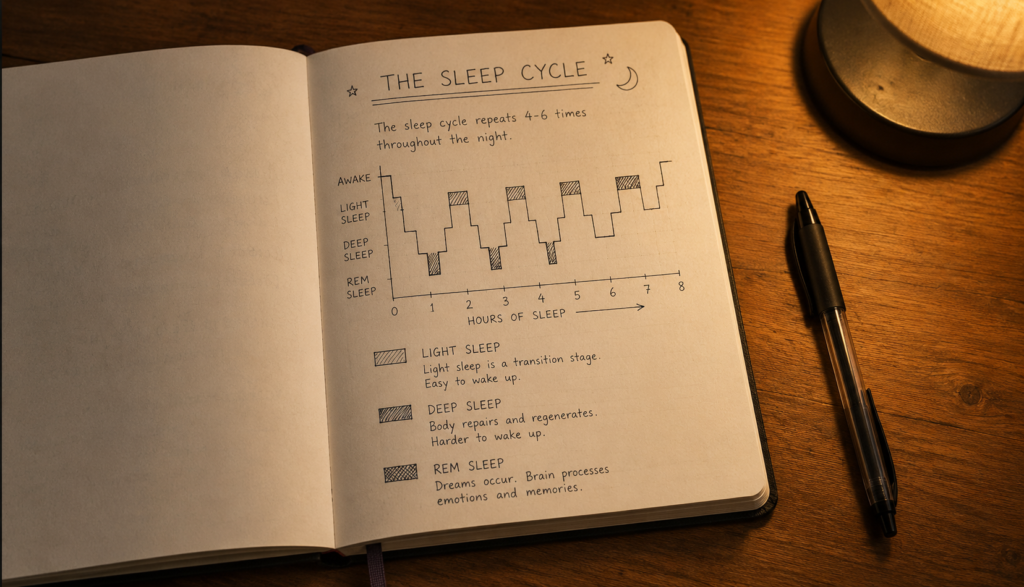
Sleep architecture moves through four stages in repeating cycles across the night, as covered in sleep stages explained. Stages 1 and 2 are light sleep — transitional phases where the body begins to slow down and sleep spindles emerge. Stages 3 and 4 are slow wave sleep, or deep sleep, where adenosine buildup from the day is cleared, the glymphatic system runs its waste-clearing process, and the body does its most intensive physical repair. REM sleep follows each cycle, handling memory consolidation, emotional processing, and BDNF production.
Core sleep maps most directly onto those deep sleep stages and the first two REM cycles of the night. These are the periods where growth hormone is released, immune system activity peaks, cortisol levels reset, and the brain consolidates the learning and experiences of the previous day. Disrupting these stages — even once — produces measurable consequences the following day in cognitive function, mood regulation, and physical health.
Most people overlook this completely: the deep sleep stages are heavily front-loaded in the night. Your first two sleep cycles — roughly the first three hours — contain the highest concentration of slow wave sleep you’ll get all night. That’s why cutting the beginning of your sleep with a very late bedtime is more damaging to core sleep than cutting the end.
REM sleep, by contrast, is back-loaded — its longest and most cognitively rich episodes come in the final hours before waking. A complete night hits both ends properly. Core sleep covers the front; the full recommended sleep duration covers the back. Both matter, but the front is what the body defends first.
How Core Sleep Differs From Total Sleep Duration
Total sleep duration is the number most people track. Core sleep is the quality underneath that number. You can spend 8 hours in bed and get poor core sleep if fragmentation repeatedly pulled you out of deep sleep stages. You can sleep 6.5 hours and get excellent core sleep if your sleep architecture ran cleanly through its cycles without interruption. Hours alone don’t tell you which situation you’re in.
This is where sleep tracking becomes genuinely useful rather than just interesting. A tracker that shows your deep sleep and REM breakdown gives you far more actionable information than total hours alone. Knowing how much deep sleep you need puts this in context — if your deep sleep is consistently under 90 minutes per night, that’s a core sleep problem regardless of what your total sleep duration looks like. If your REM sleep is fragmenting early in the morning, that’s a different problem with different causes.
Running your numbers through our REM Sleep Calculator helps identify whether your current bedtime and wake time are even giving your body the window it needs to complete core sleep stages properly — especially if you’re working with a constrained schedule.
I’ve tracked this myself across periods of different sleep schedules, and the gap between total hours and sleep quality was more significant than I expected. Weeks where I logged 7.5 hours but with poor sleep continuity felt worse than weeks where I hit 6.5 hours cleanly. The core sleep stages are what the body is actually recovering on — everything else is context.
What Disrupts Core Sleep Most

Alcohol is one of the most common and most misunderstood disruptors of core sleep. It accelerates sleep onset, which fools people into thinking it helps them sleep. What it actually does is suppress REM sleep in the first half of the night and fragment deep sleep as it metabolizes in the second half. The result is a night where total hours look fine but sleep architecture is compromised throughout. Sleep inertia the morning after alcohol is the direct result of degraded core sleep, not just the alcohol itself.
Inconsistent sleep schedules undermine core sleep by desynchronizing the circadian rhythm from the homeostatic sleep drive. Your body builds sleep pressure throughout the day and expects to release it at a consistent time anchored to your circadian rhythm. When your sleep schedule shifts by more than an hour between weekdays and weekends — the social jet lag pattern — both systems fall out of alignment, and core sleep stages are harder to reach and sustain.
The first time I really tested this was during a period where I kept a perfectly consistent bedtime for 30 days. The improvement in how I felt within the first week was more noticeable than any supplement or sleep hygiene tweak I’d tried. The circadian rhythm responds quickly when you give it consistency to lock onto.
Stress and elevated cortisol levels at bedtime are another significant disruptor. Cortisol is a waking hormone — when it’s elevated, it actively opposes the sleep pressure that drives you into deep NREM sleep. Chronic stress doesn’t just make falling asleep harder. It specifically reduces slow wave sleep depth and duration, which means it’s attacking core sleep directly. If you’re dealing with persistent sleep deprivation that doesn’t resolve despite adequate hours, cortisol management is worth examining seriously.
What Most People Don’t Know About Core Sleep and Recovery
Here’s something the mainstream sleep conversation rarely addresses: when you lose core sleep, you can’t recover it the same way you recover lost total sleep hours. A catch-up night after sleep deprivation does restore some of the slow wave sleep deficit — the brain actively rebounds on deep sleep first. But the REM sleep deficit from chronic sleep loss is harder to recover, and the cognitive and emotional impairment from disrupted core sleep can persist for several days even after you’ve returned to a full sleep schedule.
This has real implications for how people approach sleep debt. The idea that you can run short on sleep all week and recover it over the weekend works partially for total sleep duration but not cleanly for core sleep architecture. A single long Saturday sleep doesn’t fully restore the cumulative slow wave sleep deficit from five consecutive nights of poor sleep continuity. The body recovers, but slowly and incompletely.
From experience, the smarter move is to treat core sleep protection as a daily practice rather than something you catch up on reactively. Keeping your first sleep cycles — the first three hours after sleep onset — as clean and uninterrupted as possible does more for your daily function than trying to add hours on the backend of your night.
Polyphasic sleep patterns, which split sleep into multiple shorter segments across the day, work partly because they allow the body to reach core sleep stages more efficiently in each segment. But they only function sustainably when the total core sleep across all segments is genuinely protected — which is harder than it sounds without precise scheduling and significant lifestyle flexibility.
How to Protect Your Core Sleep Every Night
The single most effective thing you can do for core sleep is anchor your sleep schedule. A consistent bedtime and wake time — within 30 minutes every day including weekends — synchronizes your circadian rhythm with your homeostatic sleep drive so that when you lie down, your body is ready to move into deep sleep quickly. Sleep efficiency improves, sleep fragmentation decreases, and you spend more of your total hours in the stages that actually restore you.
Temperature plays a direct role in core sleep quality. Deep NREM sleep requires a drop in core body temperature, and a bedroom that’s too warm makes that transition harder. Keeping your sleep environment cool — around 65 to 68 degrees Fahrenheit for most people — supports the temperature drop that triggers and sustains slow wave sleep. This is one of the most consistently supported environmental factors in sleep research and one of the easiest to control.
I’ve seen this go wrong when people focus entirely on sleep duration targets while ignoring the conditions that determine sleep quality. Hitting 8 hours in a warm room with an irregular schedule and alcohol in the system produces objectively worse core sleep than 7 consistent, cool, sober hours. The number isn’t the whole story — the architecture inside it is.
If you’re dealing with chronic sleep issues that persist despite good sleep hygiene, a doctor or sleep specialist is always worth consulting — particularly if fragmentation, frequent waking, or consistently poor deep sleep shows up in your tracking data over weeks.
Frequently Asked Questions
A: Core sleep refers to the essential sleep stages — primarily deep NREM slow wave sleep and the first REM cycles — that the body prioritizes above all others. These stages drive the most critical restorative functions and are the ones the brain fights hardest to protect when sleep is restricted.
A: Core sleep is generally estimated at between 4.5 and 6 hours for most adults, representing the biological minimum for basic function. This is not a target — it is a floor. Recommended sleep for adults remains 7 to 9 hours to allow full sleep architecture completion including late-stage REM sleep.
A: Deep sleep, or slow wave sleep, is one of the primary components of core sleep. Core sleep is the broader concept covering both deep NREM stages and the early REM cycles that occur in the first half of the night. Deep sleep is the most physically restorative element within that window.
A: Short-term, the body can function on core sleep minimums, but sustained restriction to core sleep only leads to accumulating sleep debt, cognitive decline, immune system suppression, and metabolic health consequences. It is survivable briefly — not sustainably.
A: Insufficient core sleep impairs memory consolidation, mood regulation, immune function, and cognitive performance. Physical recovery slows, cortisol levels stay elevated, and the glymphatic system cannot complete its brain waste-clearing process. The effects compound quickly with repeated nights of poor core sleep.
A: Yes — significantly. Alcohol suppresses REM sleep in the first half of the night and fragments deep sleep as it metabolizes. Total sleep hours may look normal but sleep architecture is disrupted throughout, producing the tiredness and cognitive fog common after drinking even when sleep duration appears adequate.
A: Waking up genuinely rested, with stable mood and sharp focus, is the most reliable indicator. Sleep trackers that show deep sleep and REM breakdown provide more specific data. Consistently low deep sleep — under 90 minutes per night — or heavily fragmented sleep architecture suggests core sleep is being disrupted regardless of total hours.

The One Thing to Take Away
Core sleep is the non-negotiable foundation of every night. Total hours matter, but they only tell you part of the story. What happens inside those hours — whether your deep sleep stages completed properly, whether your first REM cycles ran without fragmentation — determines how you actually feel the next day far more than the number on your tracker. Protect the first three hours of your sleep above everything else, keep your schedule consistent, and treat anything that fragments those stages as a real cost rather than a minor inconvenience. That’s where the difference gets made.