
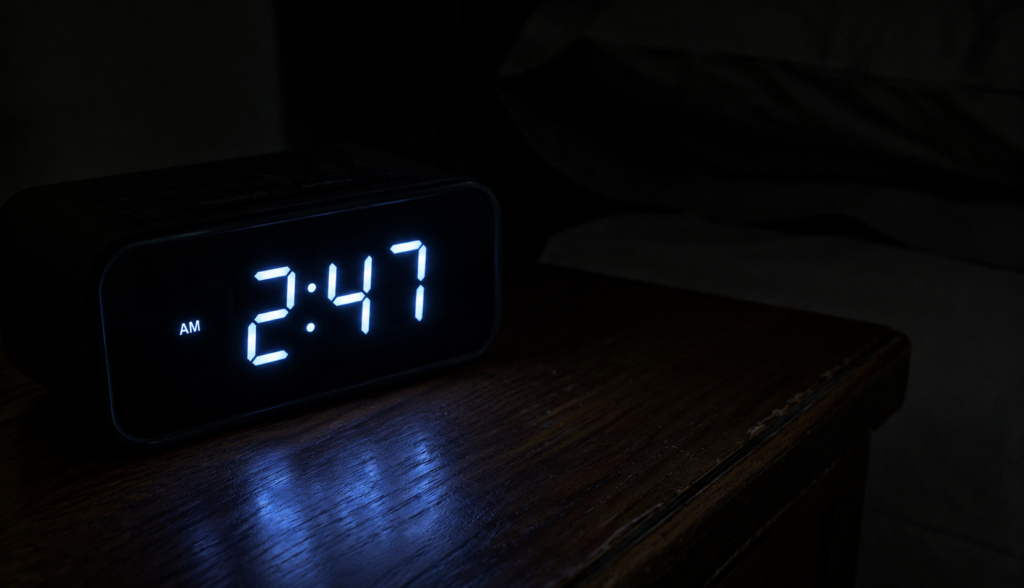
Insomnia is one of those words people use casually — a bad night, a stressful week, a period of poor sleep that resolves on its own. But clinical insomnia is something distinct and considerably more serious. It’s a pattern of difficulty initiating or maintaining sleep that persists for at least three nights per week for three months or more, causing real daytime impairment that affects work, mood, relationships, and physical health. By that definition, roughly 10 to 15 percent of adults have chronic insomnia — far more than most people realize, and far more than are ever properly treated for it.
What makes insomnia particularly difficult is that it’s self-reinforcing. The anxiety around not sleeping becomes its own obstacle to sleep — the same loop behind most nights where you simply can’t sleep no matter how tired you feel. The harder you try, the more activated your nervous system becomes, and the further away sleep gets. Standard advice — hot milk, counting sheep, going to bed earlier — not only fails to fix this loop but often makes it worse by increasing the time spent in bed awake, which trains the brain to associate the bed with wakefulness rather than sleep.
I’ve spent considerable time studying the research on insomnia treatment and tracking what actually works versus what the wellness industry promotes. The gap between those two things is significant. There is a clear, evidence-based hierarchy for treating insomnia that starts nowhere near sleep medication, and most people with chronic insomnia never reach the approaches that have the strongest outcomes.
The Two Types of Insomnia and Why the Distinction Matters
Insomnia breaks into two primary categories — sleep onset insomnia and sleep maintenance insomnia — and they have different mechanisms, different causes, and respond to different interventions. Sleep onset insomnia is difficulty falling asleep at the start of the night. Sleep maintenance insomnia is difficulty staying asleep — waking during the night and being unable to return to sleep, or waking too early in the morning. Many people experience both simultaneously, but understanding which pattern dominates gives you a far more precise starting point for addressing it.
Sleep onset insomnia is most commonly driven by hyperarousal — a state where the autonomic nervous system remains in sympathetic activation at bedtime when it should be transitioning to parasympathetic rest. Cortisol levels stay elevated, the mind races, and the physiological conditions required for sleep onset simply aren’t present despite lying in a dark quiet room. The brain is not broken — it is activated, and activation and sleep are mutually exclusive states. Anxiety and sleep have a particularly tight feedback loop here: worry about not sleeping drives further arousal, which makes sleep less likely, which generates more worry.
Sleep maintenance insomnia operates differently. It’s frequently tied to disrupted sleep architecture — fragmented sleep stages, sleep apnea causing micro-arousals, alcohol rebound in the second half of the night, or circadian rhythm misalignment that produces early morning waking before sleep need is fully met. Treating sleep maintenance insomnia with the same approach as sleep onset insomnia produces poor results because the underlying mechanism is different. Identifying which type you’re dealing with is the first diagnostic step that most self-directed approaches skip entirely.
The distinction also matters for timing interventions. Sleep onset problems respond well to pre-bed arousal reduction — winding down the nervous system before the sleep window. Sleep maintenance problems respond better to sleep architecture interventions — fixing what’s fragmenting the night rather than changing what happens before it begins. Getting this mapping right determines whether your approach will work or not.
What Causes Insomnia at the Neurological Level

The neurological model of insomnia centers on a concept called hyperarousal — a chronic elevation in the brain’s arousal systems that prevents the natural downregulation required for sleep onset and sleep maintenance. In people with chronic insomnia, the brain shows measurably higher metabolic activity during sleep than in good sleepers — more glucose consumption, more neural firing, higher core body temperature during the sleep window. The brain isn’t failing to sleep because something is missing. It’s failing to sleep because something is actively preventing the downshift.
Cortisol is the primary hormonal driver of this state. In healthy sleep, cortisol follows a diurnal rhythm — low at night, rising in the early morning to facilitate waking. In chronic insomnia, this rhythm becomes dysregulated. Cortisol stays elevated into the evening, opposes melatonin production, and keeps the autonomic nervous system in a state of readiness that is fundamentally incompatible with sleep. The adenosine buildup that should be driving sleep pressure is present — the drive to sleep is real — but the arousal system overrides it. This is why people with insomnia often feel simultaneously exhausted and unable to sleep. Both things are true at once.
Most people overlook this completely: chronic insomnia changes the brain’s relationship with the bed itself. Through a process of conditioned arousal, the bed and bedroom become associated with wakefulness, frustration, and anxiety through repeated nights of lying awake in them. The brain learns, accurately, that the bed is a place where sleep doesn’t happen — and begins generating arousal responses automatically when entering that environment. This is stimulus control gone wrong, and it explains why people with insomnia often fall asleep easily on the sofa but become wide awake the moment they move to bed. Standard sleep hygiene does not address this conditioned response. Only structured behavioral interventions do.
The homeostatic sleep drive — the pressure built from adenosine accumulation across the waking day — is also impacted by chronic poor sleep patterns. Irregular sleep schedules, excessive time in bed, and long daytime naps all reduce the adenosine buildup that drives deep, efficient sleep. The result is a system where sleep pressure is weak, arousal is high, and the brain has no strong physiological reason to consolidate sleep even when given the opportunity.
Why Standard Sleep Hygiene Advice Fails Chronic Insomnia

Sleep hygiene — consistent schedule, dark room, no screens before bed, cool temperature — is genuinely useful for people with mild or situational sleep problems. For chronic insomnia, it is almost entirely insufficient and sometimes counterproductive. The reason is that sleep hygiene addresses environmental and behavioral inputs but does nothing to resolve the conditioned hyperarousal that drives clinical insomnia. You can have a perfect sleep environment and a flawless pre-bed routine and still lie awake for two hours because the brain’s arousal system has learned to activate in that environment regardless of conditions.
Going to bed earlier is one of the most common and most counterproductive responses to insomnia. The logic feels sound — if sleep is difficult, give yourself more time for it. But spending more time in bed awake deepens the conditioned association between the bed and wakefulness, weakens sleep efficiency, and reduces the sleep pressure that would otherwise drive more consolidated sleep. The result is longer nights with worse sleep quality, more frustration, and stronger conditioned arousal. More time in bed makes chronic insomnia worse, not better, in the majority of cases.
I’ve seen this go wrong repeatedly — people extending their time in bed to 10 or 11 hours trying to catch more sleep, waking multiple times through the night, and feeling progressively more impaired rather than less. Their sleep efficiency drops below 50 percent. Their conditioned arousal strengthens. And their daytime fatigue increases because fragmented, shallow sleep is producing less restorative sleep than a shorter, consolidated night would. The intervention that feels instinctively right is making the problem measurably worse.
Sleep medication follows a similar pattern. It addresses the symptom — it produces unconsciousness — without touching the conditioned arousal, the disrupted homeostatic drive, or the circadian misalignment that maintain the insomnia. When the medication is discontinued, the insomnia returns because nothing that was generating it has changed. Sleep medication has a legitimate role in short-term acute insomnia, but as a long-term solution for chronic insomnia it is both less effective and more harmful than the behavioral interventions that actually resolve the underlying mechanism.
What Most People Don’t Know: CBT-I Outperforms Sleep Medication Long-Term
Cognitive behavioral therapy for insomnia — CBT-I — is the most effective treatment for chronic insomnia according to every major clinical guideline, including those from the American Academy of Sleep Medicine and the American College of Physicians. It outperforms sleep medication in long-term outcomes consistently and without the dependency, tolerance, and rebound insomnia that medication produces. Most people with chronic insomnia have never heard of it. Most GPs don’t lead with it. This is one of the most significant gaps between what the evidence shows and what people actually receive as treatment.
CBT-I works by directly targeting the mechanisms that maintain chronic insomnia rather than suppressing symptoms. Sleep restriction therapy — a core CBT-I component — deliberately limits time in bed to match actual sleep time, building sleep pressure and improving sleep efficiency until the brain consolidates sleep reliably again. It feels counterintuitive and uncomfortable in the first week. Sleep gets temporarily worse before it gets significantly better. This is why it requires structured guidance rather than self-directed attempts, and why people abandon it without professional support before it has time to work. Stimulus control therapy — another component — systematically breaks the conditioned association between the bed and wakefulness by restricting bed use to sleep only and removing the reinforcement of lying awake in bed night after night.
If you’re dealing with chronic sleep problems that have persisted for months, a doctor or sleep specialist is always worth consulting — CBT-I delivered by a trained therapist or through validated digital programs produces outcomes that no supplement, sleep hygiene checklist, or medication strategy can match for long-term insomnia resolution.
The mechanism is what makes CBT-I durable where medication is not. It doesn’t sedate — it rebuilds the homeostatic drive, repairs the circadian rhythm alignment, and recondititions the brain’s response to the sleep environment. Once those systems are functioning properly, they maintain themselves without continued intervention. A course of CBT-I typically runs six to eight weeks. Its benefits persist for years. That outcome profile is not replicated by any pharmacological approach currently available.
Practical First Steps Before Pursuing Clinical Treatment
Before pursuing formal CBT-I, auditing the lifestyle factors most likely to be maintaining insomnia is a worthwhile first pass — not because lifestyle change resolves clinical insomnia on its own, but because removing active disruptors gives any behavioral intervention a cleaner foundation to work from. Alcohol is the first variable to examine. It suppresses sleep architecture, elevates cortisol during metabolism, and directly worsens both sleep onset and sleep maintenance problems. Removing it for two to three weeks while tracking sleep patterns gives clear signal about how much of the insomnia it’s driving.
Stimulus control is something you can begin implementing immediately without a formal CBT-I program. Leave the bed if you’ve been awake for more than 20 minutes. Go to a different room, do something calm and non-stimulating, and return only when genuinely sleepy. This is uncomfortable and feels wrong — especially when fatigue is severe — but it begins breaking the conditioned arousal response faster than any passive approach. Every night you spend lying awake in bed deepens the association. Every night you remove yourself before frustration builds weakens it.
Taking our Insomnia Test to identify a realistic sleep window based on your actual sleep need — rather than the hours you wish you were sleeping — helps rebuild sleep pressure more efficiently.
Setting a fixed, non-negotiable wake time regardless of how the night went anchors the circadian rhythm and prevents the compensatory lie-ins that weaken homeostatic sleep drive — the same principle behind learning how to fix your sleep schedule more broadly. These two changes alone — fixed wake time and getting out of bed when awake — form the behavioral foundation of CBT-I and produce measurable improvements in sleep efficiency within two weeks for most people who apply them consistently.
FAQ
A: Insomnia is a sleep disorder characterized by persistent difficulty falling asleep, staying asleep, or waking too early, occurring at least three nights per week for three or more months and causing meaningful daytime impairment. It is distinguished from occasional poor sleep by its chronicity and the functional consequences it produces during waking hours.
A: Chronic insomnia is primarily maintained by hyperarousal — a state of elevated nervous system activation that prevents the brain from downshifting into sleep. Stress, anxiety, irregular sleep schedules, conditioned arousal from repeated nights awake in bed, alcohol, and circadian rhythm disruption are the most common contributors. The causes of onset and the causes of maintenance are often different.
A: Sleep onset insomnia is difficulty falling asleep at the beginning of the night, typically driven by hyperarousal and elevated cortisol. Sleep maintenance insomnia is difficulty staying asleep or waking too early, more commonly linked to disrupted sleep architecture, sleep apnea, alcohol metabolism, or circadian misalignment. Both can coexist and require different primary interventions.
A: Yes — CBT-I is the most effective long-term treatment for chronic insomnia, outperforming sleep medication in clinical trials consistently. It works by targeting the conditioned arousal, disrupted homeostatic drive, and sleep architecture problems that maintain insomnia rather than suppressing symptoms. Benefits persist after treatment ends, unlike medication whose effects disappear on discontinuation.
A: Sleep medication is appropriate for short-term acute insomnia but produces poor long-term outcomes for chronic insomnia. It does not address the mechanisms maintaining the condition, carries risks of dependency and tolerance, and typically produces rebound insomnia on discontinuation. Clinical guidelines recommend CBT-I as first-line treatment for chronic insomnia over pharmacological approaches.
A: Acute insomnia — triggered by a specific stressor — typically resolves within a few weeks as the situation changes. Chronic insomnia by definition persists for three months or more and rarely resolves without targeted intervention. Without addressing the underlying mechanisms of conditioned arousal and disrupted homeostatic drive, chronic insomnia can persist for years.
A: Chronic insomnia can be effectively resolved through CBT-I in the majority of cases. Most people who complete a full CBT-I program experience significant improvement in sleep efficiency, sleep onset time, and daytime functioning that is maintained long after treatment ends. Complete resolution is achievable — it requires the right intervention applied consistently, not indefinite management of symptoms.
The Right Starting Point Changes Everything

Insomnia responds to treatment — but only the right treatment applied in the right order. Sleep hygiene is not the answer for chronic insomnia. More time in bed makes it worse. Medication manages it temporarily without fixing anything. CBT-I resolves the mechanisms that maintain it and produces durable outcomes that no other approach matches. The path forward is clearer than most people with insomnia realize. The difficulty is finding it through the noise of generic sleep advice that was never designed for what they’re actually dealing with.