
The 90-minute figure gets repeated constantly in sleep advice, but most explanations stop right there without addressing why that number matters or how it should actually change anything about how you plan your sleep. A sleep cycle isn’t just a unit of time passing — it’s a structured sequence of distinct brain states, each serving a different physiological function, and understanding what’s happening inside that 90-minute window is what makes the number genuinely useful rather than just trivia.
Sleep cycle length isn’t perfectly fixed at exactly 90 minutes for everyone or every cycle within the same night — it ranges roughly between 70 and 120 minutes depending on the individual and which cycle of the night you’re in, with the first cycle typically shorter and later cycles often somewhat longer. This variability matters practically because it means rigid cycle-based sleep calculators provide useful estimates rather than precise guarantees, and understanding the underlying mechanism behind cycle timing helps explain why.
I’ve looked closely at the sleep architecture research because the casual “sleep in multiples of 90 minutes” advice that circulates widely is a reasonable approximation but skips the nuance that makes it actually work well in practice versus producing inconsistent results when applied too rigidly. Understanding both the average and the variability gives a much more accurate picture of how to actually use this information.
What Happens Inside a Single Sleep Cycle
A complete sleep cycle progresses through several distinct sleep stages, beginning with light sleep — stages 1 and 2 of NREM sleep — where the body transitions from wakefulness into a lighter, more easily disrupted sleep state.
During this transition, brain wave activity slows from the alert beta and alpha waves of wakefulness into theta waves, and sleep spindles — brief bursts of brain activity associated with memory consolidation — begin appearing, particularly in stage 2. This light sleep phase typically lasts 10 to 25 minutes at the start of a cycle and serves as the gateway into deeper sleep stages, though brief returns to light sleep also occur near the end of each cycle as a natural transition point before either waking briefly or progressing into the next cycle.
Following light sleep, the cycle progresses into slow wave sleep — stages 3 and 4 of NREM sleep, often called deep sleep — characterized by large, slow delta brain waves and the most significant physiological shutdown of the cycle. Heart rate, breathing, and core body temperature all drop to their lowest points during this stage. This is when the glymphatic system performs its most active waste-clearing work, growth hormone release peaks, and the body conducts the bulk of its physical tissue repair for the night. Deep sleep typically lasts longest during the first one to two cycles of the night and becomes progressively shorter in later cycles, which is the underlying reason how much deep sleep you need is so heavily concentrated in the early part of a full night’s sleep rather than distributed evenly across all cycles.
The cycle concludes with REM sleep, characterized by rapid eye movement, near-complete muscle atonia, and brain activity that in some measures resembles wakefulness more closely than the deep sleep stage that preceded it. REM sleep is where the majority of vivid dreaming occurs, and it’s the stage most associated with memory consolidation, particularly procedural and emotional memory processing, alongside BDNF production supporting neuroplasticity. Unlike deep sleep, REM duration increases progressively across the night, starting at just a few minutes in the first cycle and extending to 30 minutes or more by the final cycles before natural waking — which is why dreams recalled upon waking tend to come from the longer, later REM periods rather than the brief early ones.
What surprised me researching the progression through a single cycle was how asymmetric the proportions are between early and late cycles, despite each cycle being roughly similar in total duration. A first cycle might be 70 percent deep sleep and light sleep with a brief 5-minute REM period, while a sixth cycle near waking might be primarily light sleep and REM with almost no deep sleep at all — the same approximate 90-minute length but an entirely different internal composition depending on where in the night it occurs.
Why the 90-Minute Average Isn’t a Fixed Number for Everyone
Sleep cycle length varies between individuals based on factors that aren’t fully understood but appear to include age, genetics, and overall sleep health. Research measuring sleep cycle duration across large populations finds the average sits close to 90 minutes, but individual cycles for the same person can range from roughly 70 to 120 minutes depending on which cycle of the night it is and the person’s current sleep debt, stress level, and overall sleep quality on a given night. This means a sleep calculator using a flat 90-minute assumption provides a reasonable estimate for planning purposes but won’t be precisely accurate for every individual or every night.
Age significantly affects sleep cycle length, with infant sleep cycles running dramatically shorter than adult cycles — newborns cycle through their simplified two-stage sleep architecture roughly every 50 to 60 minutes, gradually lengthening toward the adult-typical 90-minute average over the first several years of life as the brain matures into the full four-stage adult sleep architecture. This is part of why infants wake more frequently throughout the night compared to adults — their cycles are genuinely shorter, producing more transition points where brief waking is more likely to occur, independent of any external disruption.
Sleep debt and overall sleep quality also influence cycle timing within the same individual across different nights. A person who is significantly sleep deprived often shows compressed sleep cycles with an accelerated transition into deep sleep, as the homeostatic sleep drive pushes the brain to prioritize the most physiologically critical stages first. This compression means cycle length and composition aren’t fixed properties of an individual but rather dynamic responses to current physiological need, which is part of why cycle-based sleep calculators work best as a general planning tool rather than a precise formula expected to be accurate to the minute on every single night.
How Many Sleep Cycles Happen in a Full Night
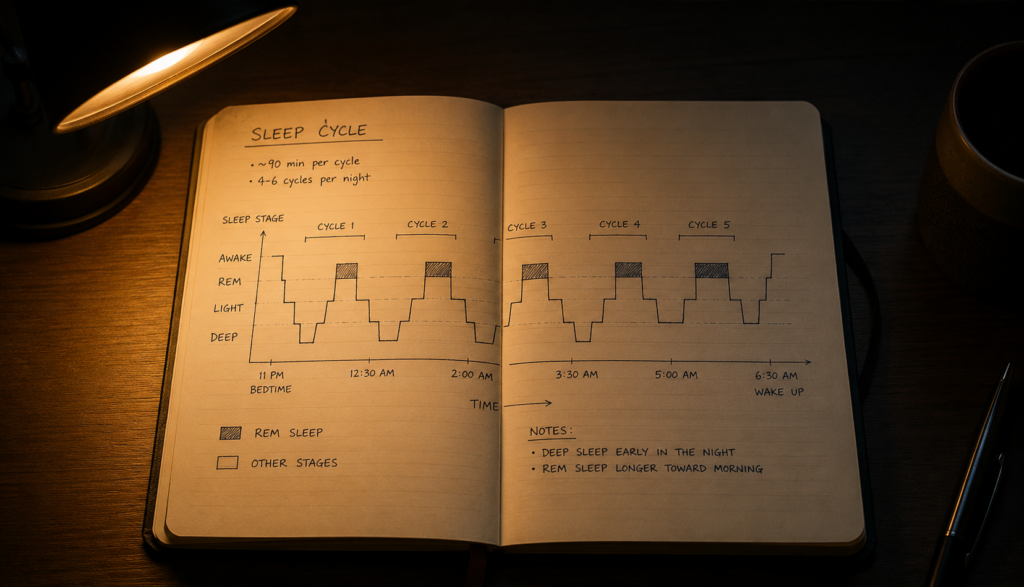
A typical adult sleeping 7 to 9 hours experiences roughly 4 to 6 complete sleep cycles per night, with the exact number depending on total sleep duration and individual cycle length. This figure is the basis for the popular advice to plan sleep duration in multiples of approximately 90 minutes — aiming for 6 hours, 7.5 hours, or 9 hours rather than an arbitrary number like 7 hours that might end a sleep period in the middle of a cycle rather than at a natural transition point between cycles.
The reasoning behind this advice connects directly to sleep inertia — the grogginess and disorientation experienced when waking during deep sleep or REM sleep rather than during the lighter sleep stages that naturally occur at the transition points between cycles. Waking during the brief light sleep phase that occurs between cycles tends to produce a noticeably easier, clearer wake-up experience compared to being pulled out of slow wave sleep or REM sleep mid-cycle, where the brain hasn’t yet begun its natural transition toward lighter sleep and wakefulness.
Most people overlook this completely: because individual cycle length varies and isn’t precisely 90 minutes for everyone, planning sleep purely around cycle multiples without any individual calibration produces a useful approximation but not a guarantee of waking during light sleep every time. A sleep calculator that accounts for your typical bedtime, accounts for some individual cycle variability, and lets you adjust based on how a particular wake time has felt in practice tends to produce better real-world results than rigid adherence to exactly 90-minute multiples regardless of how your actual cycles are running on a given night.
What Most People Don’t Know About Cycle Timing and Alarm Placement
Here’s something that gets oversimplified in most popular explanations of sleep cycle timing: the benefit of waking between cycles rather than mid-cycle is real but modest compared to the much larger effect of simply getting adequate total sleep duration in the first place. A person who sleeps a full 8 hours but happens to wake 10 minutes into a deep sleep stage will generally still feel considerably better than someone who only slept 5 hours but happened to wake during a perfectly timed light sleep transition. Cycle timing optimization is a refinement on top of adequate sleep duration, not a substitute for it, and treating precise cycle timing as more important than total sleep adequacy is a common misapplication of this otherwise useful piece of sleep science.
The practical implication is that cycle-based alarm timing produces its most noticeable benefit specifically in the narrow band of situations where someone is already getting roughly adequate total sleep but experiencing significant morning grogginess that seems disproportionate to how much they slept. In that specific scenario, adjusting wake time by 15 to 30 minutes earlier or later to land at a natural cycle transition point can produce a meaningfully easier waking experience. For someone who’s chronically sleep deprived regardless of cycle timing, the much higher-leverage fix is increasing total sleep duration first, with cycle timing optimization as a secondary refinement once adequate duration is already in place.
From experience reviewing how people actually apply sleep cycle calculators, the most common mistake is using cycle math to justify shorter total sleep duration — convincing oneself that 6 hours timed perfectly to cycle transitions is equivalent to 8 hours of adequate sleep. The research doesn’t support this. Cycle timing affects how groggy you feel in the specific moment of waking; it doesn’t meaningfully change the cumulative restorative value of 6 hours versus 8 hours of total sleep across the night. Both factors matter, but they aren’t interchangeable, and total duration carries substantially more weight for overall health and cognitive function than precise wake timing within a given night.
How to Use Sleep Cycle Knowledge Practically
Using our Sleep Cycle Calculator to work backward from a fixed required wake time, in approximate 90-minute increments while still prioritizing adequate total sleep duration of 7 to 9 hours for most adults, gives a reasonable starting point for cycle-aware sleep planning.
Using a sleep calculator that allows you to input your typical sleep onset latency — the time it actually takes you to fall asleep after getting into bed, which varies meaningfully between individuals — improves the accuracy further, since cycle counting from the moment you get into bed rather than from actual sleep onset introduces a systematic error equal to whatever your personal sleep onset latency happens to be.
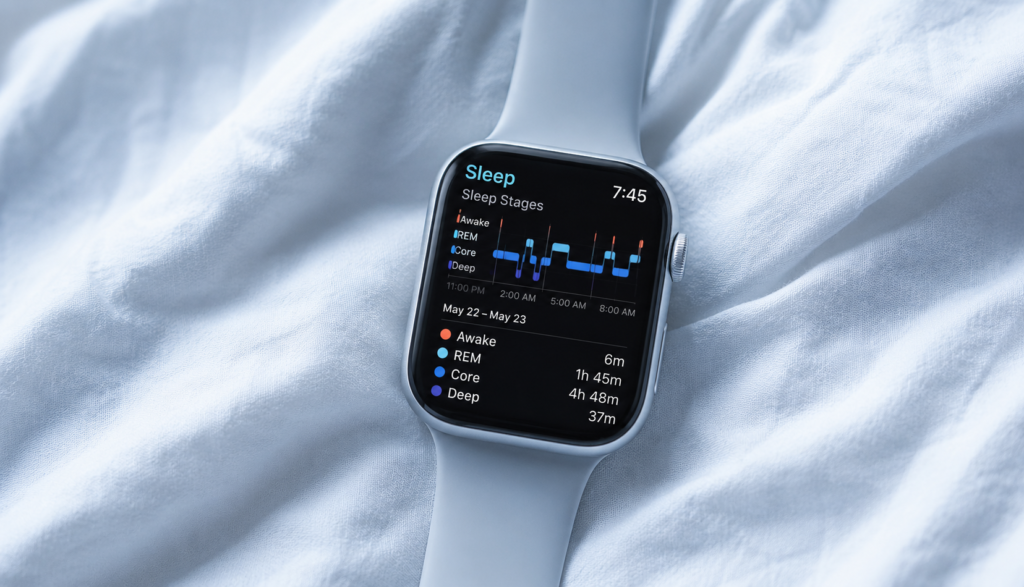
Tracking your own experience of waking at different times relative to estimated cycle transitions, ideally with a basic sleep tracker that estimates sleep stages, gives you individual calibration data that a generic 90-minute calculation can’t provide. Over a few weeks of tracking, most people can identify roughly how their personal cycle length and sleep onset timing actually run, allowing for more individually accurate sleep planning than relying purely on population averages.
If sleep cycle disruption is severe and persistent — frequent waking that doesn’t resolve with adequate sleep duration and reasonable cycle timing, or consistent inability to progress normally through sleep stages — a doctor or sleep specialist is always worth consulting, since conditions like sleep apnea can fragment sleep cycles in ways that no amount of timing optimization or duration increase can resolve without addressing the underlying disruption directly.
FAQ

A: A sleep cycle averages approximately 90 minutes, though individual cycles can range from roughly 70 to 120 minutes depending on the person and which cycle of the night it is. Cycles progress through light sleep, deep sleep, and REM sleep, with the internal composition changing across the night.
A: Most adults experience 4 to 6 complete sleep cycles during a typical 7 to 9 hour night. This is the basis for the common recommendation to plan sleep duration in approximate 90-minute multiples, aiming to wake near a natural cycle transition point rather than mid-cycle.
A: Waking during deep sleep or REM sleep produces sleep inertia — grogginess and disorientation — because the brain hasn’t begun its natural transition toward lighter sleep. Waking during the brief light sleep phase between cycles tends to feel noticeably clearer because that transition has already begun naturally.
A: No. Sleep cycle length varies by individual and by age, with infants cycling roughly every 50 to 60 minutes and adults averaging closer to 90 minutes. Cycle length within the same person also varies somewhat across the night and depending on factors like sleep debt and overall sleep quality.
A: No — total sleep duration matters considerably more than precise cycle timing for overall health and cognitive function. Cycle timing primarily affects how groggy you feel in the specific moment of waking, while total duration determines the cumulative restorative value of the night’s sleep. Both matter, but they are not interchangeable.
A: Yes. Infant sleep cycles are significantly shorter than adult cycles, gradually lengthening toward the adult average over early childhood. Older adults often experience more fragmented sleep with lighter stages and more frequent brief wakings, which can affect overall cycle composition even if average cycle length stays similar.
A: Sleep calculators provide a useful approximation based on population averages but cannot precisely predict individual cycle timing, which varies by person and by night. Combining calculator estimates with personal sleep tracking data over time produces more individually accurate planning than relying on a flat 90-minute assumption alone.