
Deep sleep is the stage most people have heard of but few actually understand. It’s the part of the night where the body does its most serious work — clearing metabolic waste from the brain, releasing growth hormone, rebuilding tissue, resetting the immune system. And it’s the stage that gets cut first when sleep goes wrong. You can spend 8 hours in bed and walk away with under an hour of slow wave sleep if the conditions aren’t right. That’s the gap most sleep advice never addresses properly.
The frustrating truth about deep sleep is that you can’t force it. You can’t decide to have more of it the way you can decide to go to bed earlier. What you can do is remove the things that suppress it and build the conditions that allow it to occur naturally and deeply. That distinction matters enormously — because most people trying to increase deep sleep are focused on adding things when the real leverage is in removing what’s blocking it.
I spent a long time chasing supplements and gadgets before I understood that. The moment I started auditing what was actively suppressing my slow wave sleep instead of looking for something to boost it, the numbers on my tracker shifted faster than anything I’d tried before. The blockers are almost always the bigger problem.
What Deep Sleep Actually Is and Why It’s So Hard to Get More Of
Deep sleep — technically stages 3 and 4 of NREM sleep, also called slow wave sleep — is one of the core components of what is core sleep, characterized by large, slow delta brain waves and a state of genuine physiological shutdown. Heart rate drops, breathing slows, core body temperature falls, and the brain becomes largely unresponsive to external stimuli. This is the stage where the glymphatic system runs its overnight waste-clearing process, flushing out metabolic byproducts including beta-amyloid — a protein associated with cognitive decline when it accumulates over time.
It’s also when growth hormone release peaks, driving physical repair, muscle recovery, and cellular maintenance throughout the body.
Deep sleep is heavily concentrated in the first half of the night. Your first two sleep cycles — roughly the first three hours after sleep onset — contain the highest proportion of slow wave sleep you’ll get all night. Each subsequent cycle produces less deep sleep and more REM sleep. This front-loading means that anything disrupting the early part of your night — a late bedtime, alcohol metabolizing, elevated cortisol at sleep onset — hits your deep sleep disproportionately hard compared to disruptions later in the night.
The reason deep sleep is difficult to increase on demand is that it’s primarily driven by adenosine buildup — the chemical that accumulates in the brain throughout the day as a byproduct of neural activity. The longer and more consistently you’ve been awake, the higher your sleep pressure, and the more efficiently your brain converts that pressure into deep slow wave sleep when you do sleep. Disrupting sleep timing, napping strategically at the wrong time, or going to bed before genuine sleep pressure has built adequately all reduce the depth and duration of slow wave sleep regardless of any other optimization.
Understanding this mechanism reframes the entire approach to increasing deep sleep. The goal isn’t to manufacture more of it — it’s to stop undermining the conditions the brain needs to produce it naturally. If your homeostatic sleep drive is intact and your sleep architecture isn’t being disrupted, deep sleep takes care of itself.
Temperature Is the Most Underrated Deep Sleep Lever
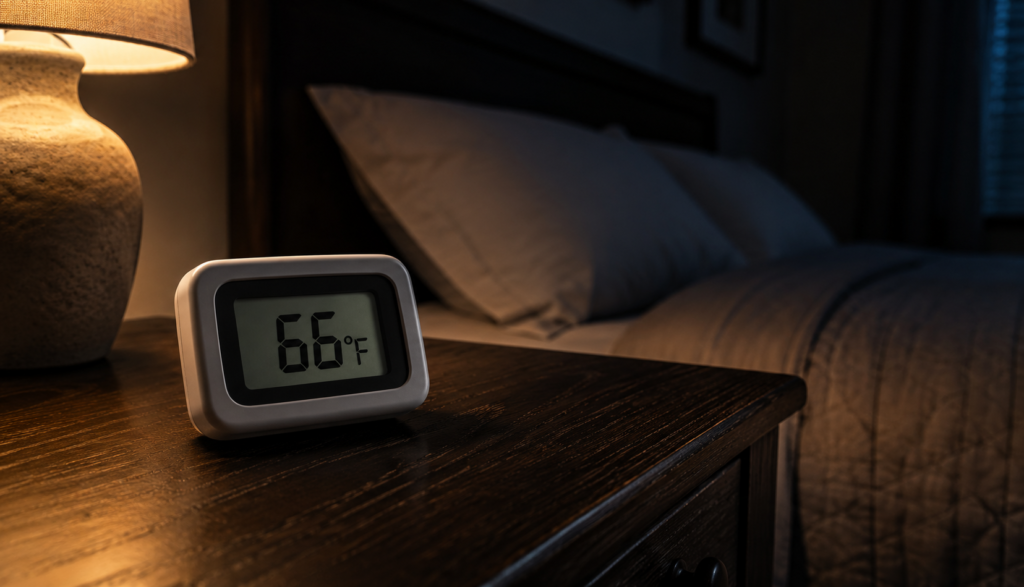
Core body temperature and deep sleep have a direct, well-established relationship that most people completely ignore. Slow wave sleep onset requires a measurable drop in core body temperature — the body needs to cool down to shift into the deep stages of NREM sleep. When your sleep environment is too warm, that cooling process is impaired, and the brain stays in lighter sleep stages rather than descending into slow wave sleep. The hours accumulate, but the depth doesn’t.
The best temperature for sleep for most adults sits between 65 and 68 degrees Fahrenheit — cooler than most people keep their bedrooms. The mechanism is straightforward: as the body cools, blood vessels in the hands and feet dilate to radiate heat away from the core, signaling the brain that the conditions for deep sleep are met. A warm room prevents this heat dissipation, keeping core temperature elevated and slow wave sleep shallow or abbreviated.
What surprised me was how quickly this single change produced measurable results. Within a week of dropping my room temperature by four degrees, my deep sleep percentage on my tracker increased noticeably — without changing anything else. Temperature regulation is one of the few environmental levers that directly influences sleep architecture rather than just making sleep easier to initiate. It’s worth treating as a genuine priority rather than a comfort preference.
A warm shower or bath 60 to 90 minutes before bed works through the same mechanism in reverse — it raises surface temperature briefly, which triggers the body to accelerate its cooling response afterward, dropping core temperature faster than it would naturally. This pre-sleep temperature drop primes the system for deeper slow wave sleep in the first cycle, which is where the majority of your deep sleep budget sits anyway.
How Exercise Timing Directly Shapes Deep Sleep Quality
Exercise is one of the most reliable ways to increase deep sleep, but the timing and type matter more than most people realize. Physical activity increases adenosine buildup during the day, which strengthens sleep pressure and drives deeper slow wave sleep when you do sleep. It also triggers BDNF production — brain-derived neurotrophic factor — which supports the neurological processes that deep sleep facilitates, creating a reinforcing loop between daytime activity and nighttime recovery quality.
Aerobic exercise produces the most consistent improvements in slow wave sleep depth and duration across the research literature. Moderate-intensity cardio — running, cycling, swimming — done earlier in the day appears to have the strongest effect on deep sleep architecture that night. Resistance training also contributes, particularly because the physical repair demands it creates drive growth hormone release during subsequent deep sleep stages, making those stages both deeper and more metabolically active.
Timing matters significantly. Vigorous exercise within two to three hours of bedtime elevates core body temperature, increases cortisol levels, and activates the autonomic nervous system in ways that actively suppress deep sleep onset. The body needs time to wind down from intense physical effort before it can transition smoothly into slow wave sleep. Morning or afternoon exercise consistently outperforms late-evening exercise for deep sleep quality, even when total sleep duration remains identical. The first time I shifted my training from 9pm to 7am for a month, the deep sleep improvement was the most immediate change I noticed — faster than any dietary adjustment I’d made.
What Most People Don’t Know About Alcohol and Deep Sleep

Alcohol is the single most common deep sleep suppressant that people routinely underestimate. Most people know alcohol affects sleep in some vague way — they’ve heard it disrupts REM sleep. What they don’t know is the specific mechanism by which it attacks slow wave sleep, and why that mechanism makes even moderate drinking far more damaging to deep sleep quality than it appears on the surface.
When alcohol metabolizes — typically in the second half of the night — it triggers a rebound in the autonomic nervous system that elevates cortisol and shifts the brain out of deep NREM sleep into lighter stages. Cortisol is a waking hormone that directly opposes the neurological conditions required for slow wave sleep. As it rises during alcohol metabolism, the brain is pulled progressively into lighter sleep stages even while the body remains physically still and technically asleep. The result is a night where total sleep duration looks normal but deep sleep is abbreviated to a fraction of what a sober night produces. Standard sleep hygiene advice — consistent schedule, dark room, no screens — cannot compensate for this. As long as alcohol is present during the metabolizing window, the deep sleep suppression occurs regardless of every other factor.
From experience, even two drinks consumed four to five hours before bed produce a measurable reduction in slow wave sleep percentage on a tracker. The window of impact is longer than most people assume because metabolism rate varies significantly by body weight, liver function, and what was eaten. If deep sleep is a genuine priority, alcohol on any night — not just immediately before bed — is the variable most worth addressing first.
Sleep Schedule Consistency and the Circadian Deep Sleep Window
Your circadian rhythm doesn’t just regulate when you feel sleepy — it actively gates which sleep stages are available at which times. Deep sleep is most accessible during a specific window aligned with your biological night, and that window shifts when your sleep schedule is inconsistent. Going to bed two hours later on weekends than weekdays doesn’t just reduce your sleep duration — it displaces your deep sleep window, meaning the hours you do sleep contain less slow wave sleep than they would on a consistent schedule.
This is why sleep schedule consistency is one of the highest-leverage changes you can make for deep sleep specifically. A consistent bedtime anchors your circadian rhythm so that when you lie down, your body is at the exact point in its biological cycle where the conditions for slow wave sleep are optimal. Sleep pressure from adenosine buildup is at its peak. Core body temperature is dropping on schedule. Melatonin production has been running for the right amount of time. All three systems align to produce deep sleep efficiently rather than fighting each other because the schedule shifted.
Using our Sleep Quality Calculator to identify your optimal bedtime based on your required wake time gives you a concrete target that accounts for full sleep cycles rather than just total hours.
The goal is to build your sleep window so that your deep-sleep-heavy early cycles land at the right biological time — not just any time that adds up to enough hours on paper. Consistency within that window, maintained across weekdays and weekends without more than 30 minutes of variation, is what allows the circadian and homeostatic systems to work together rather than against each other.
Magnesium, Supplements, and What the Evidence Actually Supports
Magnesium is the supplement with the strongest evidence base for supporting deep sleep, and it works through a specific mechanism rather than general sedation. Magnesium regulates GABA receptors in the brain — GABA being the primary inhibitory neurotransmitter that slows neural activity and facilitates the transition into slow wave sleep. It also regulates the autonomic nervous system, reducing the sympathetic activation that keeps the brain in lighter sleep stages. Magnesium glycinate and magnesium threonate are the forms most commonly cited in sleep research, with threonate having some evidence for crossing the blood-brain barrier more effectively than other forms.
The effect of magnesium supplementation is most pronounced in people who are deficient — which, given how common dietary magnesium deficiency is, covers a significant portion of the population. If your diet is low in leafy greens, nuts, seeds, and whole grains, supplementing magnesium before bed is one of the few additions that has genuine mechanistic support for improving deep sleep quality rather than just sleep onset speed.
Most other popular sleep supplements — melatonin, valerian, L-theanine — primarily affect sleep onset rather than deep sleep architecture. Melatonin signals the circadian system that it’s time to sleep but doesn’t directly drive slow wave sleep depth. It’s useful for circadian rhythm correction and jet lag, but it won’t meaningfully increase your deep sleep percentage if the real blockers are temperature, alcohol, inconsistent schedule, or elevated cortisol. Fixing those first produces larger and more durable improvements than any supplement stack.
Frequently Asked Questions
A: The most effective natural approaches are keeping a consistent sleep schedule, cooling your bedroom to 65 to 68 degrees Fahrenheit, exercising earlier in the day, eliminating alcohol on nights where deep sleep is a priority, and building adequate sleep pressure through full waking hours before bed. These target the mechanisms that produce slow wave sleep rather than just adding hours.
A: Most adults need between 90 minutes and 2 hours of deep sleep per night, representing roughly 20 to 25 percent of total sleep duration. Consistently falling below 90 minutes of slow wave sleep — as shown on a sleep tracker — typically produces measurable impairment in physical recovery, immune function, and cognitive performance the following day.
A: Yes — significantly and consistently. Alcohol suppresses slow wave sleep by triggering a cortisol rebound during metabolism in the second half of the night. Even moderate drinking several hours before bed produces measurable reductions in deep sleep percentage. No other sleep hygiene factor compensates for this effect while alcohol is present in the system.
A: Yes. Physical activity — particularly aerobic exercise — increases adenosine buildup during the day, strengthening sleep pressure and driving deeper slow wave sleep. Morning and afternoon exercise produces the strongest improvements. Late-evening vigorous exercise can suppress deep sleep by elevating core temperature and cortisol close to bedtime.
A: A bedroom temperature between 65 and 68 degrees Fahrenheit supports the core body temperature drop required for slow wave sleep onset. Warmer environments impair this cooling process and keep the brain in lighter sleep stages even when total sleep duration is adequate. Temperature is one of the most direct environmental levers for improving deep sleep architecture.
A: Magnesium has the strongest evidence base among supplements for supporting deep sleep. It regulates GABA receptors and the autonomic nervous system, both of which facilitate the transition into slow wave sleep. The effect is most pronounced in people with dietary magnesium deficiency. Magnesium glycinate and threonate are the forms most commonly cited in sleep research.
A: Low deep sleep despite adequate total hours is almost always caused by a specific disruptor — alcohol, warm bedroom temperature, inconsistent sleep schedule, elevated cortisol from stress, or sleep apnea fragmenting sleep architecture. Tracking deep sleep percentage rather than total hours is the first step toward identifying which factor is responsible in your specific case.
The Real Work Is Removing What Blocks It
Deep sleep doesn’t need to be manufactured — it needs to be allowed. The body knows how to produce slow wave sleep efficiently when the conditions are right. A cool room, a consistent schedule, adequate sleep pressure built through full waking hours, and the removal of the handful of habits that chemically and physiologically suppress it — that’s the entire framework. Start with the blockers before you look for boosters. The deep sleep was always there. The goal is to stop getting in the way of it.