
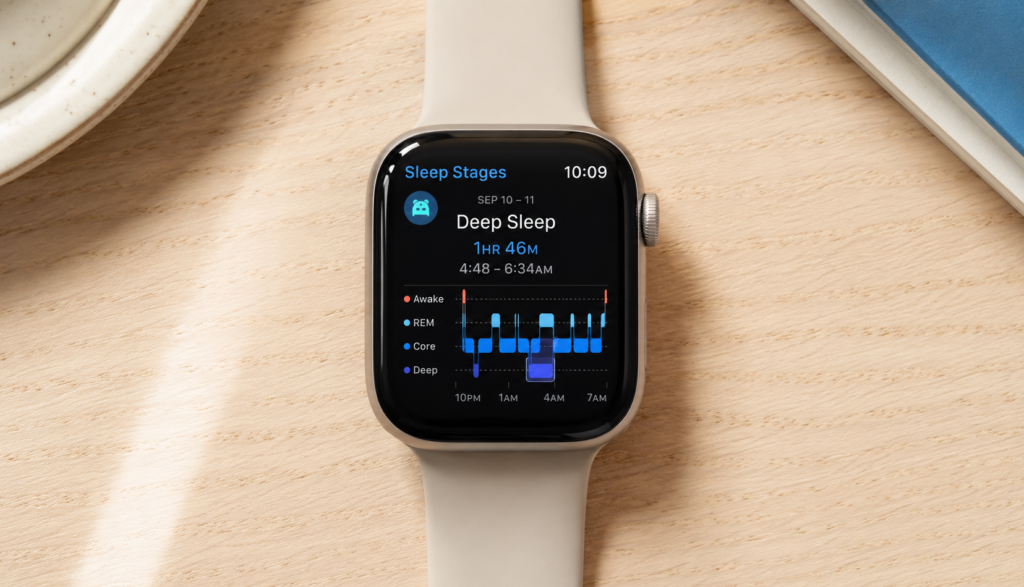
Deep sleep gets more attention than any other sleep stage, and for good reason — it’s where the body does its most intensive physical repair work, where the brain clears the metabolic waste that accumulates during waking hours, and where the foundational restorative processes that determine how you physically feel the next day primarily occur. The question of how much you need is straightforward to answer at the population level, but understanding why that number varies, what drives it lower, and how to interpret what your sleep tracker is actually showing you requires considerably more nuance than the headline figure provides.
The standard answer is that adults need roughly 1.5 to 2 hours of deep sleep per night, representing approximately 20 to 25 percent of total sleep duration for a typical 7 to 8 hour night. This figure comes from population-level polysomnography data — laboratory sleep studies measuring brain wave activity directly — and represents the range associated with optimal physical recovery, cognitive function, and long-term health outcomes. Falling consistently below 90 minutes of deep sleep per night produces measurable impairment across multiple systems, even when total sleep duration appears adequate on paper.
I’ve spent considerable time examining what the research actually shows about deep sleep thresholds and variability because the tracker data most people now have access to is useful but often misread, leading to either unnecessary anxiety about deep sleep numbers that are actually within a normal range or missed signals about genuine deficits that warrant attention. Understanding the mechanism behind the numbers makes the data far more actionable.
What Deep Sleep Is Actually Doing During Those 90 Minutes
Deep sleep — stages 3 and 4 of NREM sleep, also called slow wave sleep — is one of the most intensively studied of the sleep stages, characterized by large, synchronized delta brain waves that represent the most complete withdrawal of the brain from external awareness achievable during sleep.
Heart rate, breathing rate, and core body temperature all reach their lowest points of the night during slow wave sleep, and the body’s metabolic rate drops significantly as resources are redirected from maintenance of conscious function toward repair and restoration. This physiological profile is what makes deep sleep genuinely different from lighter sleep stages rather than simply a deeper version of the same process.
The glymphatic system — the brain’s dedicated waste-clearing pathway — operates most actively during slow wave sleep, using cerebrospinal fluid to flush out metabolic byproducts including beta-amyloid and tau proteins that accumulate during waking neural activity. This clearance process is essential for long-term brain health and represents one of the clearest mechanistic links between inadequate deep sleep and increased long-term risk of neurodegenerative conditions. The clearance that doesn’t happen during one night of insufficient slow wave sleep doesn’t fully catch up in subsequent nights, meaning the deficit accumulates over time in a way that goes beyond how you feel the following morning.
Growth hormone release follows a distinct peak during the first and second deep sleep cycles of the night — typically in the first three to four hours of sleep — driving tissue repair, muscle protein synthesis, and cellular maintenance across the body. This is why deep sleep deprivation produces physical recovery deficits that go beyond cognitive impairment, affecting how the body repairs muscle damage from exercise, recovers from illness or injury, and maintains overall physical condition. The growth hormone link also explains why athletes in training periods report increased deep sleep need — higher physical repair demands require more of the slow wave sleep that drives the repair process.
Most people overlook this completely: the deep sleep stages are also when immune system activity peaks, with cytokine production and immune memory consolidation occurring disproportionately during slow wave sleep. People who are fighting off illness or recovering from infection often show increased slow wave sleep as a direct physiological response to elevated immune system demand, in the same way athletes show increased deep sleep during intensive training. The body actively increases deep sleep when the need for its specific functions is higher — which is part of why forced early wake times during illness feel particularly difficult and counterproductive.
How Deep Sleep Changes Across the Night and With Age
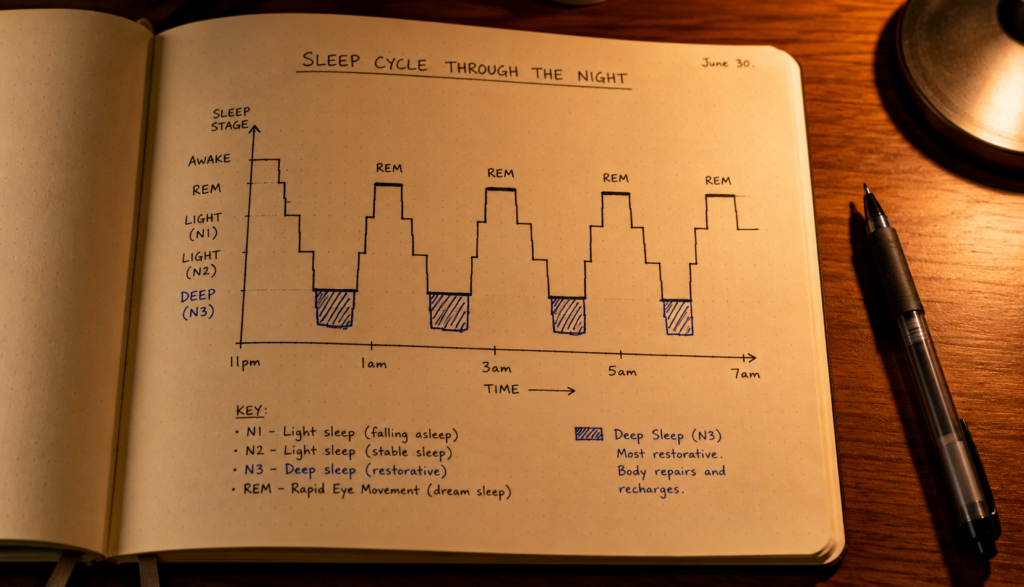
Deep sleep isn’t distributed evenly across a full night — it follows a strongly front-loaded pattern that makes the first half of the night disproportionately important for slow wave sleep specifically. The first two sleep cycles of the night contain the highest concentration of deep sleep you’ll get across the entire night, with each subsequent cycle progressively reducing the proportion of slow wave sleep in favor of longer REM periods. By the fourth or fifth cycle, very little deep sleep remains in the cycle composition, with the sleep architecture shifting almost entirely to light sleep and extended REM stages.
This front-loading has a critical practical implication: anything that disrupts the early part of the night — a very late bedtime, alcohol consumed in the evening, elevated cortisol levels from late-night stress, or an inconsistent sleep schedule that misaligns the homeostatic sleep drive with the circadian rhythm — hits deep sleep disproportionately hard compared to anything disrupting the later hours. Cutting two hours from the end of your sleep costs primarily REM sleep. Cutting two hours from the beginning of your sleep, or fragmenting the first few cycles through any mechanism, costs primarily deep slow wave sleep. These are not equivalent losses.
Age significantly reduces deep sleep percentage and duration, with a well-documented and substantial decline beginning in early adulthood and continuing progressively across the lifespan. Young adults in their twenties typically spend 20 to 25 percent of total sleep in slow wave sleep. By middle age, this often drops to 10 to 15 percent, and older adults frequently show slow wave sleep percentages below 10 percent or sometimes nearly absent in laboratory measurements. This age-related decline isn’t considered pathological in itself — it reflects normal changes in sleep architecture — but it does mean older adults produce less slow wave sleep even when sleeping adequately by total duration standards, and that the consequences of further reducing it through lifestyle factors become proportionally more significant as the baseline declines.
Reading Your Sleep Tracker’s Deep Sleep Numbers Accurately
Consumer sleep trackers have made deep sleep data widely accessible, which is broadly positive for sleep awareness but has also created a significant source of anxiety for people whose trackers consistently show deep sleep figures that seem low. The important context is that consumer trackers — wrist-based accelerometers and heart rate monitors — estimate sleep stages through movement and heart rate variability rather than directly measuring brain wave activity the way polysomnography does. These estimates are useful directional indicators but carry meaningful inaccuracy at the stage level, often underestimating or inconsistently detecting deep sleep specifically because the heart rate and movement signatures of deep sleep can be harder to distinguish from light sleep compared to REM sleep.
This means a tracker showing 60 minutes of deep sleep on a given night isn’t necessarily evidence of a 60-minute deep sleep deficit from the 90-minute target. It may reflect an actual deficit, or it may reflect measurement limitations producing an undercount. The more reliable signal from a consumer tracker isn’t any single night’s deep sleep figure but rather the trend across multiple nights and the correlation between deep sleep estimates and how you actually feel — whether low deep sleep nights consistently predict worse recovery and function the following day compared to higher deep sleep nights.
Using our REM Sleep Calculator alongside your tracker data helps put total sleep duration and cycle timing in context, making it easier to identify whether a consistently low deep sleep reading is more likely explained by insufficient total sleep, something actively suppressing slow wave sleep, or tracker measurement limitations.
People who consistently report low deep sleep on their tracker but feel genuinely rested and recovered are more likely experiencing tracker underestimation than an actual deficit.
What Most People Don’t Know: Deep Sleep Rebounds After Deprivation
Here’s a property of deep sleep that reveals something important about how the brain prioritizes it: slow wave sleep shows a strong homeostatic rebound after deprivation. When deep sleep is selectively restricted — through forced waking during slow wave stages in laboratory experiments — the brain responds on subsequent recovery nights by dramatically increasing the proportion and intensity of slow wave sleep, actively prioritizing the most physiologically critical stage as the sleep system attempts to repay the specific deficit created. This rebound is significantly more pronounced and rapid for deep sleep than for any other sleep stage, with the brain compressing more slow wave sleep into recovery nights with greater intensity than it would produce on normal undisturbed nights.
This rebound mechanism tells us something fundamental about how the brain ranks deep sleep relative to other sleep stages — it’s treated as the highest-priority stage when resources are constrained, recovered most urgently after deprivation, and protected most tenaciously when total sleep time is restricted. From a practical standpoint, this means that a single night of low deep sleep is far less concerning than a pattern of consistently low slow wave sleep over weeks, since the rebound mechanism provides partial recovery between isolated nights. A persistent pattern without rebound, by contrast, suggests something is actively suppressing slow wave sleep — not allowing the natural recovery mechanism to function — which points toward a specific disruptor worth identifying.
From experience reviewing how this pattern plays out, the most common persistent suppressors of deep sleep that override the rebound mechanism are alcohol consumed regularly in the evenings, chronically elevated cortisol from unmanaged stress, sleep apnea fragmenting the deep sleep stages before they can complete, and consistently inadequate total sleep duration that prevents the homeostatic drive from building enough pressure to produce extended slow wave sleep. Identifying and removing whichever of these is active does more to restore adequate deep sleep than any additive approach, because the brain’s own rebound mechanism handles the recovery once the suppression is lifted.
What to Do If Your Deep Sleep Is Consistently Low
Before treating low deep sleep numbers as a problem requiring intervention, establish first whether the signal is genuine. Compare how you feel on higher and lower deep sleep nights using your tracker. If there’s a consistent correlation between lower deep sleep and worse physical recovery, cognitive sharpness, or morning energy levels, the signal is likely meaningful. If low deep sleep nights don’t produce noticeably different daytime function, the tracker may simply be underestimating rather than detecting a genuine deficit.
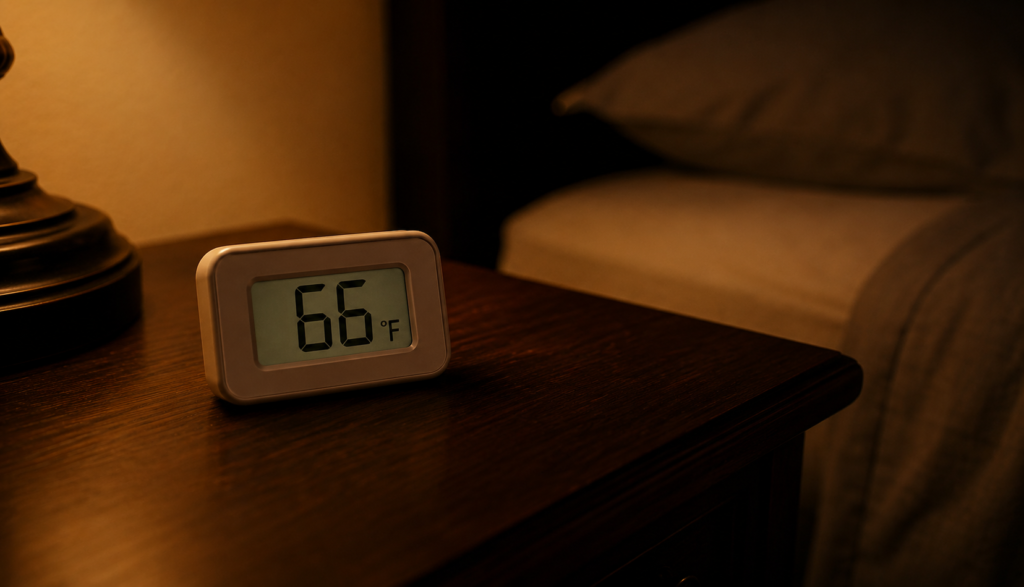
If the signal does appear genuine, the highest-leverage interventions target the most common suppressors in order of likelihood. Eliminate or substantially reduce alcohol in the evenings, since its suppression of slow wave sleep through the cortisol rebound during metabolism is the most potent and most common deep sleep reducer in the population. Cool the bedroom to the 65 to 68 degree Fahrenheit range, since core body temperature drop is a physiological prerequisite for entering and sustaining slow wave sleep. Establish a consistent sleep schedule that keeps the first few hours of the night — where deep sleep is concentrated — at the same clock time each night, since schedule variability disrupts the alignment between homeostatic sleep pressure and the circadian timing that optimizes deep sleep production.
Exercise earlier in the day — aerobic activity specifically — increases slow wave sleep on subsequent nights through both the physical repair demands it creates and the increased adenosine buildup from greater daily activity. The timing matters because late-evening vigorous exercise can elevate cortisol and core body temperature close to bedtime in ways that actually reduce the deep sleep it would otherwise support if performed earlier. If deep sleep remains consistently and significantly low despite these adjustments, a doctor or sleep specialist is always worth consulting — sleep apnea in particular produces deep sleep fragmentation that no lifestyle optimization can resolve without addressing the underlying airway issue.
FAQ

A: Most adults need between 90 minutes and 2 hours of deep sleep per night, representing roughly 20 to 25 percent of a 7 to 8 hour night. Consistently falling below 90 minutes of slow wave sleep is associated with impaired physical recovery, immune function, and cognitive performance regardless of total sleep duration.
A: Insufficient deep sleep impairs the glymphatic system’s brain waste clearance, reduces growth hormone release affecting physical repair, weakens immune system function, and degrades the metabolic restoration processes that determine physical recovery. These effects accumulate with repeated nights of inadequate slow wave sleep and are not fully offset by adequate total sleep duration alone.
A: Slow wave sleep percentage declines progressively from young adulthood onward, reflecting normal changes in sleep architecture rather than pathology. Young adults typically achieve 20 to 25 percent deep sleep, while older adults often show percentages below 10 percent. This age-related decline makes protecting the remaining slow wave sleep from lifestyle suppressors increasingly important.
A: Yes — deep sleep shows a strong homeostatic rebound after deprivation. The brain actively prioritizes and intensifies slow wave sleep on recovery nights after insufficient deep sleep, producing higher proportions and greater intensity than on undisturbed nights. This rebound is more pronounced for deep sleep than any other sleep stage.
A: Yes — significantly. Alcohol consumed in the evening triggers a cortisol rebound during metabolism that suppresses slow wave sleep in the second half of the night. Even moderate evening drinking produces measurable reductions in deep sleep percentage, and this suppression overrides the natural rebound mechanism if alcohol is consumed regularly.
Protect the Hours That Matter Most
Deep sleep is the stage the body fights hardest to protect and recovers most urgently when it’s lost — that biological priority tells you everything you need to know about how seriously to take it. The target of 90 minutes to 2 hours per night is achievable for most people when the primary suppressors are removed, the bedroom is cool, and the sleep schedule is consistent enough to keep the deep-sleep-heavy early cycles landing at the right time each night. Start with what’s suppressing it before looking for ways to add more.