
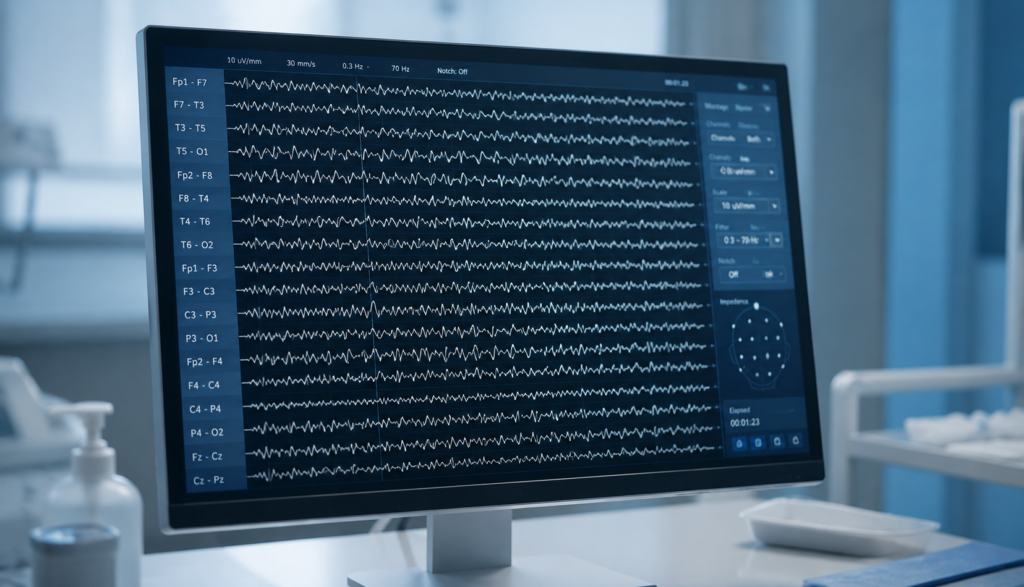
Sleep looks passive from the outside, but inside the brain it’s one of the most physiologically active and organized periods of the entire day. Rather than a single uniform state of unconsciousness, sleep is a structured sequence of four distinct stages — each with its own brain wave signature, physiological profile, and specific biological function — cycling through the night in a predictable pattern that the body has evolved to depend on entirely. Understanding what each stage actually does changes how you think about sleep quality, sleep duration, and what you’re actually losing when those stages get disrupted.
The staging system used in modern sleep medicine divides sleep into NREM sleep — non-rapid eye movement sleep — covering three stages of progressively deeper sleep, and REM sleep — rapid eye movement sleep — where dreaming, emotional processing, and certain forms of memory consolidation primarily occur. Each of these stages serves functions the others don’t, which is why all four need to be present in adequate amounts for sleep to be genuinely restorative rather than simply a period of unconsciousness that passes the hours until morning.
I’ve gone through the polysomnography literature on sleep stage functions because the popular summary — “deep sleep restores the body, REM restores the mind” — while directionally correct, misses enough nuance to be genuinely misleading in how people interpret their own sleep data and what they prioritize when trying to improve sleep quality.
Stage 1 NREM: The Gateway Into Sleep
Stage 1 is the lightest and briefest sleep stage, typically lasting only one to seven minutes during the initial transition from wakefulness and representing roughly 5 percent of total sleep time across the night. During this stage, brain wave activity transitions from the alert beta waves and relaxed alpha waves of wakefulness into the slower theta waves associated with drowsiness and early sleep. Muscle activity decreases, eye movements slow to a rolling pattern, and the sensory threshold for external disturbance — the loudness of a noise or the brightness of a light required to wake someone — begins rising above the waking level, though someone in stage 1 remains easily arousable.
This stage is where hypnic jerks commonly occur — those sudden, involuntary muscle contractions that feel like falling and frequently startle people awake just as they’re drifting off. These are a normal feature of the stage 1 to early stage 2 transition and reflect the gradual relaxation of muscle tone as the nervous system shifts from waking control patterns to sleep states. They’re more common when someone is overtired, stressed, or has consumed caffeine, but their occasional occurrence in relaxed, well-rested individuals is still entirely normal and not a sign of any underlying problem.
Stage 1 sleep serves as an essential transition zone rather than a deeply restorative stage in its own right. The homeostatic sleep drive and circadian rhythm alignment that together produce the conditions for sleep onset operate primarily through this gateway stage — it’s where the body tests whether conditions are adequate to proceed into deeper sleep or whether something in the environment or physiology is pulling consciousness back toward wakefulness. People who find themselves cycling repeatedly through stage 1 without progressing into deeper stages are typically experiencing elevated arousal from stress, cortisol, environmental disturbance, or some other factor that’s preventing the deeper sleep stages from engaging properly.
Stage 2 NREM: Light Sleep With Significant Functions
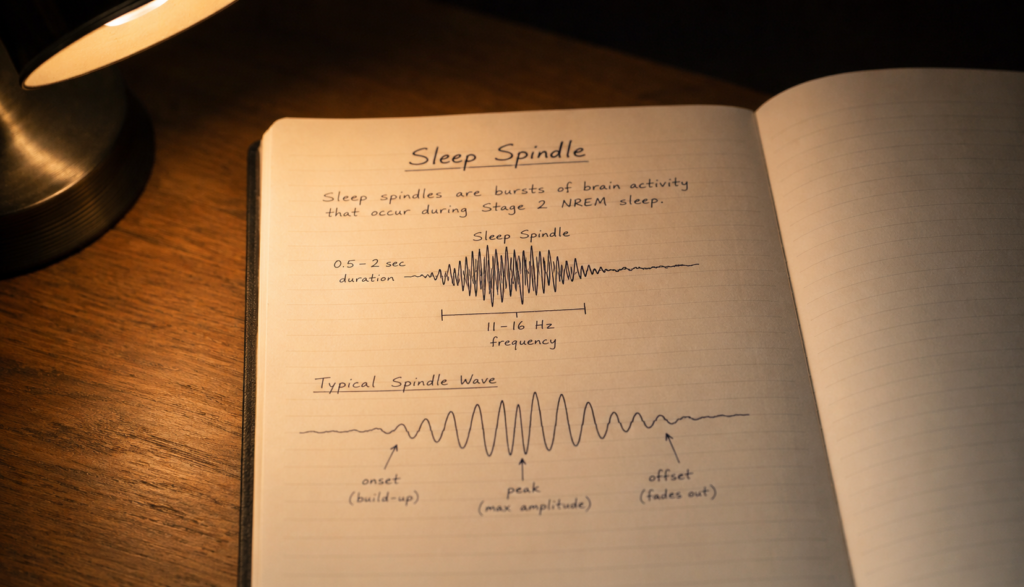
Stage 2 is the most numerically dominant sleep stage across a full night, typically accounting for 45 to 55 percent of total sleep time in healthy adults and representing the foundation of what most people experience as the bulk of their night’s sleep. Brain wave activity in stage 2 is primarily theta waves punctuated by two distinct electrical events that are measurable on EEG and serve specific cognitive functions — sleep spindles and K complexes. Sleep spindles are brief bursts of rapid brain activity lasting half a second to two seconds that appear to play a direct role in memory consolidation, specifically in the transfer and integration of newly learned information. K complexes are large, sharp wave patterns that occur in response to environmental stimuli and are thought to serve a sleep-protective function, suppressing full arousal in response to sounds or other disturbances that don’t actually require waking.
The sleep spindle density — how frequently and intensely spindles occur during stage 2 — varies between individuals in ways that correlate with certain cognitive abilities, particularly in learning efficiency and intelligence measures, making stage 2 far more functionally significant than its light sleep classification might suggest. Stage 2 is also when heart rate and breathing continue to slow from their stage 1 levels and core body temperature drops further toward the level required for deep sleep to begin, making it a physiologically preparatory stage for what follows as much as a functionally independent one.
Most people overlook this completely: the “power nap” that produces genuine cognitive benefit rather than grogginess typically targets stage 2 sleep specifically rather than deep sleep, because 15 to 20 minutes of stage 2 sleep provides meaningful restoration through spindle-associated consolidation without producing the sleep inertia that results from waking mid-deep sleep. The restorative value of stage 2 is often underestimated because it lacks the dramatic associations of slow wave sleep or REM, but its dominance across the night by percentage reflects its genuine functional importance rather than simply being filler between the more attention-grabbing stages.
Stage 3 NREM: Slow Wave Sleep and Physical Restoration
Stage 3 — slow wave sleep, or deep sleep — is the stage most directly associated with physical restoration and is characterized by the large, synchronized delta brain waves that give it its technical name. During slow wave sleep, the brain achieves its most complete withdrawal from external awareness, with the arousal threshold at its highest point of the night — it takes significantly louder noise or more sustained stimulation to rouse someone from stage 3 than from any other sleep stage, and when arousal does occur from deep sleep it produces pronounced sleep inertia as the brain attempts to rapidly transition from its most downregulated state to wakefulness.
The glymphatic system — the brain’s cerebrospinal fluid-based waste clearance network — runs at peak efficiency during slow wave sleep, flushing metabolic byproducts including beta-amyloid and tau proteins out of the brain tissue. This clearance process is dependent on specific changes in brain cell volume that occur during slow wave sleep, where brain cells actually contract slightly to create more interstitial space for cerebrospinal fluid flow — a process that simply doesn’t occur at the same efficiency during lighter sleep stages. Growth hormone release peaks during the first one to two slow wave sleep cycles of the night, driving tissue repair, muscle protein synthesis, and cellular maintenance across the body. Immune system activity — cytokine production, immune memory formation — is also concentrated in this stage, explaining why the body actively increases slow wave sleep duration when fighting infection or recovering from physical stress.
From experience researching how various factors affect this specific stage, the thing that stands out most clearly is how many common behaviors selectively suppress slow wave sleep without proportionally affecting other stages — alcohol being the most significant and most common, with its cortisol rebound during metabolism specifically targeting and reducing slow wave sleep duration in the second half of the night while leaving total sleep hours superficially intact. This selective suppression is what makes alcohol’s effect on sleep quality so much worse than simply reducing total sleep duration by an equivalent amount, since the stages with the most distinctive and irreplaceable functions are disproportionately affected.
REM Sleep: Memory, Emotion, and the Dreaming Brain
REM sleep — rapid eye movement sleep — is the most neurologically active sleep stage and, in certain EEG measures, the closest to wakefulness of all the sleep stages despite being associated with the deepest dreaming and the most complete behavioral unconsciousness. Brain activity during REM is intense and widespread, with the visual cortex, emotional processing regions including the amygdala, and memory systems all showing high activation levels. Heart rate and breathing become irregular and faster compared to NREM stages, and the eyes move rapidly behind closed eyelids in the pattern that gives this stage its name — movements that appear correlated with the visual processing occurring in the dreaming brain.
Muscle atonia — the near-complete paralysis of voluntary muscles during REM sleep — is one of its most distinctive and functionally important features. The brainstem actively inhibits motor neurons during REM, preventing the body from physically acting out the movements in dreams. This atonia is both a protective mechanism and a defining physiological marker of the stage, measured in sleep laboratories as part of standard polysomnography. REM behavior disorder — a condition where this atonia fails to engage properly — results in people physically acting out their dreams with potentially serious consequences, and its occurrence can be an early neurological signal worth clinical investigation.
Memory consolidation during REM sleep operates differently from the consolidation occurring during stage 2. While stage 2 spindles are associated with procedural and factual learning, REM sleep appears most critical for emotional memory processing, creative insight, and the integration of new information into existing knowledge frameworks — a more associative and abstract form of consolidation compared to the more direct encoding of stage 2. This is part of why people often report solving problems or gaining new perspectives on difficulties after sleeping, and why the advice to “sleep on it” before making a complex decision has genuine mechanistic support beyond folk wisdom. BDNF production, supporting neuroplasticity and the strengthening of synaptic connections, also occurs prominently during REM sleep, linking this stage directly to the brain’s ongoing capacity for learning and adaptation.
What Most People Don’t Know: How Sleep Stage Proportions Shift Through the Night
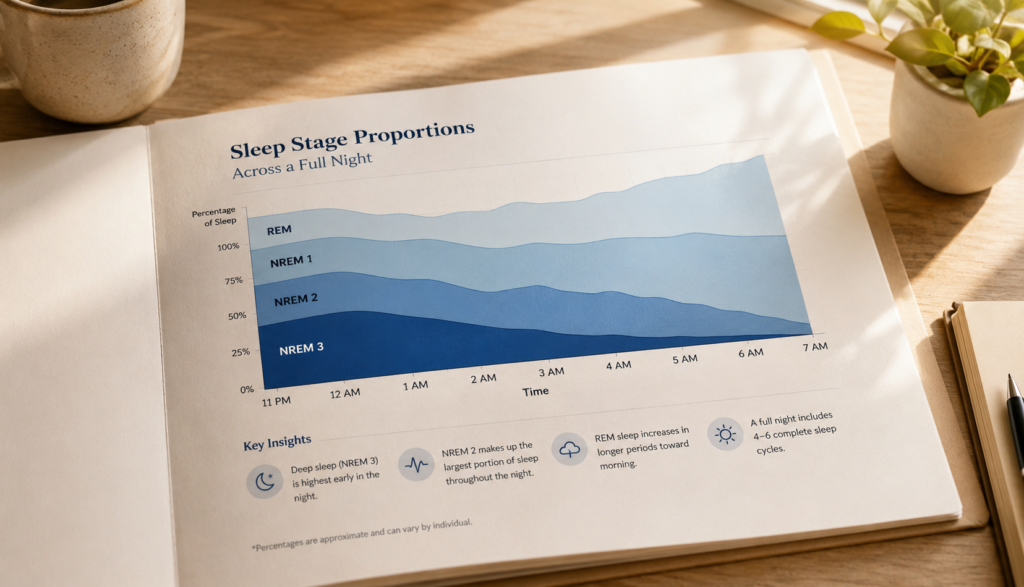
Here’s the aspect of sleep stage architecture that most people don’t realize despite knowing the individual stage names: the proportions of each stage change dramatically across the course of a full night in a predictable pattern, meaning the same total sleep duration can contain very different compositions of sleep stages depending on which hours those hours actually cover. The first half of a typical night is heavily weighted toward slow wave sleep — the deep NREM stages dominate the first two to three cycles, with relatively brief REM periods completing each cycle. The second half of the night reverses this distribution almost entirely, with slow wave sleep becoming minimal or absent in later cycles while REM periods extend progressively to 30 minutes or more by the final cycle before waking.
The practical consequence of this distribution is that cutting sleep from different ends of the night produces fundamentally different deficits. A late bedtime that shortens the night from the front cuts primarily into the slow wave sleep concentrated in early cycles, reducing the physical restoration, glymphatic clearance, and growth hormone release that depend on those early deep sleep stages. An early wake time that shortens the night from the back cuts primarily into the extended REM periods of the final cycles, reducing emotional processing, creative consolidation, and the memory integration functions specific to late-night REM sleep. Neither deficit is equivalent to the other, and neither is a simple fraction of a missed percentage of total sleep — they represent qualitatively different kinds of sleep stage loss with qualitatively different functional consequences.
I’ve seen this go wrong when people treat all hours of sleep as interchangeable, concluding that six hours of sleep ending at 6am is functionally equivalent to six hours ending at 8am. It isn’t — those last two hours contain a disproportionate amount of the night’s total REM sleep, which is also why learning how to wake up without an alarm tends to feel so different from an abrupt cutoff, meaning an earlier wake time loses a qualitatively different and in some respects more cognitively significant portion of the sleep cycle than a later bedtime would cost in terms of deep sleep. Both matter; they’re just not the same thing. Using our Sleep Cycle Calculator to visualize which sleep stages your specific bedtime and wake time are most likely covering can make this tradeoff concrete rather than abstract.
How All Four Stages Work Together
Understanding the four sleep stages individually is useful, but the more important insight is that they function as an integrated system rather than four separate modules that can be optimized or sacrificed independently. Each stage prepares for the next — stage 1 gates the entry into stage 2, stage 2 bridges into slow wave sleep, slow wave sleep is followed by brief lightening back toward stage 2 before transitioning into REM, and REM concludes each cycle with a brief lightening that may produce a partial waking before the next cycle begins. Disrupting any stage tends to affect the quality and duration of subsequent stages within the same cycle, which is part of why sleep fragmentation from any cause — sleep apnea, noise, alcohol, stress — degrades sleep quality beyond simply the time lost in the disruption itself.
Sleep efficiency — the ratio of time actually spent in productive sleep stages to total time in bed — is the metric that best captures this integrated functioning, because it reflects whether the cycling between stages is occurring effectively or whether something is repeatedly pulling the sleep architecture back toward lighter stages and wakefulness before the cycle completes. People with chronic sleep disturbances often have adequate total sleep duration by the clock but dramatically reduced sleep efficiency, spending more of their night in light sleep and stage 1 transitions — and accumulating more microsleep episodes during the day as a result — rather than progressing through the full depth of each cycle’s slow wave and REM stages.
If sleep stage data from a tracker or sleep study consistently shows significant abnormalities — near-absent slow wave sleep, severely fragmented REM, or very low sleep efficiency despite adequate time in bed — a doctor or sleep specialist is always worth consulting, since these patterns can indicate conditions like sleep apnea, REM behavior disorder, or other sleep architecture disruptions that lifestyle optimization alone cannot address.
FAQ: Sleep Stages Explained

A: There are four sleep stages — three NREM stages (stage 1 light sleep, stage 2 light sleep, and stage 3 slow wave deep sleep) and one REM stage. These four stages cycle repeatedly throughout the night in roughly 90-minute cycles, with the proportion of each stage shifting as the night progresses.
A: All four stages serve distinct functions that the others don’t replicate, making none truly dispensable. Slow wave sleep is most critical for physical restoration, immune function, and brain waste clearance. REM sleep is most critical for emotional memory processing, creative consolidation, and neuroplasticity. Stage 2 contributes significantly to procedural memory consolidation through sleep spindles.
A: During REM sleep, brain activity intensifies to near-waking levels, vivid dreaming occurs, the eyes move rapidly behind closed eyelids, and voluntary muscles are temporarily paralyzed through motor neuron inhibition. Memory consolidation, emotional processing, creative insight, and BDNF production supporting neuroplasticity all occur prominently during this stage.
A: Slow wave sleep drives the glymphatic system’s brain waste clearance, peaks growth hormone release for physical repair, supports immune system cytokine production, and achieves the lowest metabolic rate of the night. These functions don’t occur at the same efficiency during lighter stages, making adequate deep sleep duration genuinely irreplaceable.
All Four Stages, Every Night
Sleep stages aren’t interchangeable units of rest — each serves functions the others can’t replicate, and the integrated cycling between them is what transforms sleep from mere unconsciousness into the genuinely restorative process the body depends on. Protecting adequate duration of all four stages, rather than just total sleep hours, is the more precise and more useful goal for anyone taking sleep quality seriously. The body handles the specific scheduling when given enough time and the right conditions — the work is mostly in removing what’s disrupting the cycling rather than trying to engineer individual stage durations directly.