

The idea that 5am is the universally optimal wake time gets repeated in productivity circles with enough confidence that it’s easy to assume there’s strong science behind it. There isn’t — at least not as a universal claim. The research on wake time and outcomes is considerably more nuanced, pointing toward consistency and alignment with individual biology rather than any specific clock time as the primary driver of how rested, alert, and productive a morning actually feels. Five in the morning is genuinely optimal for some people and genuinely terrible for others, and the difference isn’t discipline — it’s chronobiology.
The best time to wake up for any specific person sits at the intersection of three factors: their individual chronotype, which determines when their circadian rhythm naturally produces peak sleepiness and peak alertness; their total sleep need, which determines how many hours before the wake time they need to go to sleep to wake adequately rested; and the practical constraints of their life, which set the range within which the ideal can actually operate. Understanding each factor and how they interact gives a far more actionable answer to this question than any single clock time recommendation ever could.
I’ve looked through both the chronobiology research and the practical data on wake time optimization specifically because the cultural narrative around early rising oversimplifies something that’s genuinely individual in important ways. The person who reads about 5am rising, tries it for two weeks while fighting their biology the entire time, and concludes they’re not a morning person isn’t wrong about themselves — they may simply have a chronotype that makes 5am genuinely suboptimal for their specific biology regardless of how much they want it to work.
How Chronotype Determines Your Natural Wake Time
Chronotype is the biological tendency toward earlier or later timing across the sleep-wake cycle — the internal disposition that makes some people naturally alert and functional at 6am while others don’t reach their cognitive peak until late morning or early afternoon. Chronotype is primarily driven by genetics, with specific variants in clock genes like PER3 and CLOCK associated with morning and evening tendencies, and it’s distributed across the population in a bell curve ranging from extreme morning types through the large intermediate middle to extreme evening types. It is not primarily a matter of habit, discipline, or lifestyle choice — it’s a biological reality that sleep medicine recognizes as a genuine source of individual variation in sleep timing needs.
Morning chronotypes — sometimes called larks — have circadian rhythms that run slightly ahead of the average, producing natural sleepiness earlier in the evening and natural waking earlier in the morning without external prompting. Their cortisol awakening response peaks earlier, their core body temperature rises earlier, and their cognitive performance peaks earlier in the day compared to intermediate and evening types. For these individuals, a 5am or 6am wake time genuinely aligns with their biology, and they perform at their best in the early morning hours that evening types find painful.
Evening chronotypes — sometimes called owls — have circadian rhythms that run slightly behind the average, producing natural sleepiness later and natural waking later without external prompting. Their peak cognitive performance arrives later in the day, their melatonin drop morning timing is delayed, and their cortisol awakening response peaks later than morning types regardless of what time they go to sleep. For these individuals, an early forced wake time consistently produces significant sleep inertia and morning impairment that doesn’t resolve quickly, because they’re being woken during a circadian phase that their biology treats as the middle of their biological night. Forcing a 5am wake time on a genuine evening chronotype doesn’t convert them to a morning person — it chronically sleep-deprives them and degrades their performance across the day.
The intermediate chronotype — which represents the majority of the population — sits between these extremes and has the most flexibility in adjustable wake times, though even intermediate types show meaningful individual variation in where within their manageable range they perform best. Understanding your own chronotype, rather than assuming a universal ideal applies to you, is the prerequisite for identifying your genuinely optimal wake time rather than one borrowed from someone with a different biological clock.
Sleep Cycle Timing and Why Your Wake Time Should Align With It
Beyond chronotype, the specific clock time you wake up shapes the experience of waking through its relationship to where in your sleep cycle the alarm interrupts. Waking during the light sleep phase at the natural transition point between cycles produces noticeably clearer, less groggy waking compared to being pulled out of deep sleep or REM sleep mid-cycle, which produces the sleep inertia that makes some mornings feel genuinely awful regardless of total sleep duration. This cycle timing effect is why two people sleeping identical hours can have dramatically different morning experiences based purely on what their alarm happens to interrupt.
Properly calculating sleep means accounting for typical sleep onset latency — the time it actually takes you to fall asleep after getting into bed — and working backward from a target wake time in 90-minute cycle increments, giving a concrete starting point for identifying bedtimes that are likely to land the wake time near a natural cycle transition rather than mid-cycle.
The result isn’t guaranteed precision, since individual cycle length varies somewhat from the 90-minute average and shifts across the night, but it produces considerably better average waking experience than choosing a bedtime based purely on total hours without considering cycle alignment.
The practical application is to identify two or three candidate wake times that align with cycle-appropriate sleep durations — 7.5 hours, 6 hours, or 9 hours being the most commonly cited cycle-aligned durations for a standard 90-minute cycle — and test each for a week to observe which produces the clearest morning waking experience. This individual testing accounts for the cycle length variability that makes a population-average calculation imprecise at the individual level, replacing a theoretical estimate with direct observation of actual waking quality across multiple mornings.
The Cortisol Awakening Response and Why Consistency Matters More Than Time
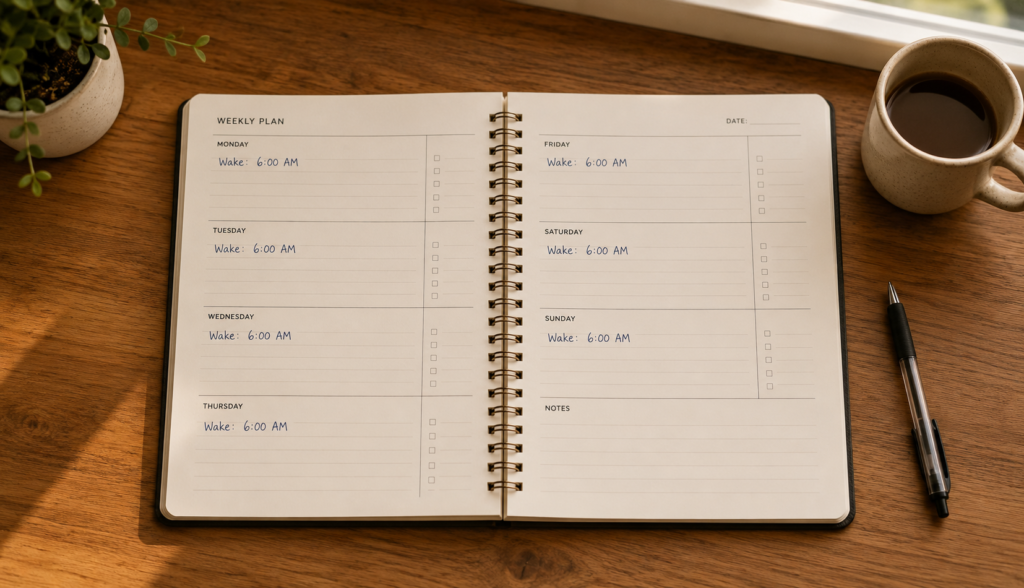
The cortisol awakening response — the sharp rise in cortisol that the circadian clock initiates roughly 30 minutes before the anticipated wake time — is the physiological mechanism most responsible for how alert and functional the first hour of a morning actually feels. This response is timed by the internal clock to the expected wake time, meaning it builds calibration accuracy with schedule consistency. A wake time held consistently across all seven days, including weekends, for two to three weeks produces a noticeably more robust cortisol awakening response than the same average wake time maintained inconsistently — the biology requires the stability to know when to prepare.
This is the most compelling argument for wake time consistency over any specific clock time: the cortisol awakening response that makes mornings feel clear and functional is calibrated by the circadian clock to a stable expected time. Shift that time by two hours on weekends — the social jet lag pattern — and the clock loses its calibration anchor, producing a weaker and mistimed cortisol response that contributes to the grogginess and impaired function that characterizes Monday mornings for so many people. The Monday morning fog is largely a symptom of social jet lag rather than anything inherent about Monday itself.
I’ve tracked this myself across periods of consistent versus variable wake times, and the difference in first-hour alertness quality is more pronounced than I initially expected. The consistent schedule period produces a qualitatively different kind of morning — one where alertness arrives more quickly and more completely, without the extended transition period of fog that characterizes inconsistent-schedule mornings. The specific time mattered less than the consistency with which that time was maintained across the week.
What Most People Don’t Know: Earlier Isn’t Always Better for Productivity
Here’s something the early-rising productivity narrative consistently gets wrong: cognitive performance quality in the first few hours after waking is partly determined by chronotype in a way that makes an early wake time actively counterproductive for evening types in terms of actual output quality, not just comfort. Evening types who force a 5am or 6am wake time don’t simply experience worse mornings — they perform measurably worse on tasks requiring complex reasoning, creativity, and working memory during those early forced-morning hours compared to what they would produce at their natural chronotype-aligned wake time and subsequent peak hours. The productivity gain that a morning-type person genuinely experiences from early rising isn’t available to an evening type at that same clock time because the circadian phase of peak cognitive performance hasn’t arrived yet regardless of when they woke up.
Research comparing cognitive performance across chronotypes at matched versus mismatched times consistently finds that performance peaks align with chronotype-appropriate hours rather than absolute clock times — a morning type’s peak performance hours and an evening type’s peak performance hours may be four to five hours apart for the same tasks. Forcing either chronotype to do complex cognitive work at the other’s optimal clock time produces measurably worse output, meaning the insistence that 5am is universally optimal for productivity confuses a genuine truth for morning types with a universal principle that doesn’t transfer across the full chronotype distribution.
The most productive wake time is the one that allows adequate total sleep duration, aligns with the circadian phase where your specific cognitive performance actually peaks, and can be maintained consistently enough for the cortisol awakening response to calibrate properly. For a morning type with a 9am to 5pm schedule and a natural sleep need of 7.5 hours, that might genuinely be 5am or 6am. For an evening type with the same schedule and sleep need, it’s more likely 7am or 7:30am — earlier than their ideal, but the closest achievable alignment that doesn’t chronically deprive them of the sleep and circadian alignment their biology requires for actual functional performance.
Finding Your Personal Optimal Wake Time
Identifying your actual optimal wake time rather than adopting one from external recommendation starts with an honest assessment of your chronotype. If left entirely without schedule constraints — no alarms, no obligations — what time do you naturally fall asleep and what time do you naturally wake? This free-running schedule, observed over at least a week of genuinely unconstrained sleep, reveals your biological preference more accurately than any questionnaire or productivity advice. The natural wake time from this observation is your chronotype baseline — the starting point from which practical life constraints will require some adjustment, but the biological anchor against which those adjustments should be evaluated.
From that baseline, work backward from your required wake time — the earliest you need to be functional for work, school, or family obligations — and identify what time you should go to bed to provide your full sleep need in cycle-aligned increments.
If the required wake time is significantly earlier than your natural chronotype wake time, the gap represents a genuine mismatch that will produce some performance cost regardless of how well everything else is optimized. Acknowledging that mismatch honestly is more productive than assuming discipline or routine can override the circadian biology driving it.
For people whose required wake time is severely misaligned with their chronotype — particularly those with delayed sleep phase syndrome who face significant occupational or social consequences from the mismatch — a doctor or sleep specialist is always worth consulting. Chronobiological interventions including timed light therapy and carefully managed melatonin supplementation can shift the circadian phase meaningfully over time, potentially narrowing the gap between biological preference and required schedule in ways that voluntary schedule adjustments alone cannot achieve. Using our Chronotype Calculator consistently to track bedtimes and wake times alongside subjective morning alertness ratings over several weeks provides the data needed to identify which specific combinations produce your best mornings and refine toward a genuinely personalized optimal schedule.
FAQ: Best Time to Wake Up

A: There is no single universally optimal wake time — it depends on chronotype, individual sleep need, and practical schedule constraints. The best wake time is the one that allows adequate total sleep duration, aligns with your natural circadian phase, lands near a natural sleep cycle transition point, and can be held consistently enough for the cortisol awakening response to calibrate properly.
A: For genuine morning chronotypes, yes — their circadian rhythm is naturally aligned with earlier wake times, and 5am or 6am falls within their biological optimal range. For evening chronotypes, forcing a 5am wake time produces chronic circadian misalignment, sleep deprivation, and measurably worse cognitive performance in those early hours, making it actively counterproductive rather than beneficial.
A: Yes — significantly. Waking near a natural sleep cycle transition point rather than mid-deep-sleep or mid-REM reduces sleep inertia and produces clearer morning waking despite identical total sleep duration. Waking at a time aligned with your cortisol awakening response — through consistent scheduling — also produces noticeably better first-hour alertness than waking at an inconsistent or chronotype-misaligned time.
A: For most people, yes. A consistent wake time maintained across all seven days allows the cortisol awakening response to calibrate accurately, produces more reliable morning alertness, and prevents the social jet lag that degrades function at the start of each week. Within a reasonable range, the specific clock time matters less than the consistency with which it’s maintained.
A: The most productive wake time is chronotype-dependent — morning types peak cognitively in early morning hours, while evening types reach their cognitive peak several hours later regardless of when they woke up. Forcing either type to do complex work during the other’s optimal hours produces measurably worse output, meaning the productive wake time is the one aligned with your specific chronotype rather than a universal early-morning ideal.
The Best Wake Time Is Yours, Not Everyone Else’s
The optimal wake time isn’t 5am, 6am, or any other specific number — it’s the time that lets you wake from a completed sleep cycle, within your chronotype’s natural range, consistently enough for the cortisol awakening response to work properly. Find that time by observing your own biology rather than borrowing someone else’s schedule, build your bedtime backward from it to ensure adequate sleep duration, and hold it consistently enough across the week for the circadian system to calibrate. Everything else about a good morning follows from that foundation.