
Most people calculate their sleep the same way — subtract bedtime from wake time and compare the result to eight hours. If the number is close enough, they assume the night was adequate. If it’s short, they feel guilty. Neither response captures what’s actually important about sleep duration, because hours alone don’t tell you whether those hours contained the sleep stages your body needed, whether you woke at a natural cycle transition or mid-deep-sleep, or whether your total sleep is accumulating debt or clearing it. Calculating sleep properly requires a slightly more sophisticated framework than simple subtraction — and once you understand it, the math is straightforward and considerably more useful.
A sleep calculator built on sleep cycle timing rather than raw hours gives you two specific things that total-hours counting doesn’t: a more cycle-aligned bedtime that improves waking experience, and a clearer picture of whether your overall sleep duration is meeting your actual sleep needs rather than just approaching an arbitrary target. These are different questions with different answers, and treating them separately makes the calculation genuinely actionable rather than a number you compare to a benchmark and move on from.
I’ve tested sleep calculation approaches across extended periods of tracking because the difference between sleeping hours that happen to align well with sleep cycle timing and hours that don’t is one of the most consistently noticeable quality-of-life differences in sleep, and most people are making this calculation in the least useful way possible without realizing a better approach is available.
The Foundation: How Sleep Cycles Change What the Numbers Mean
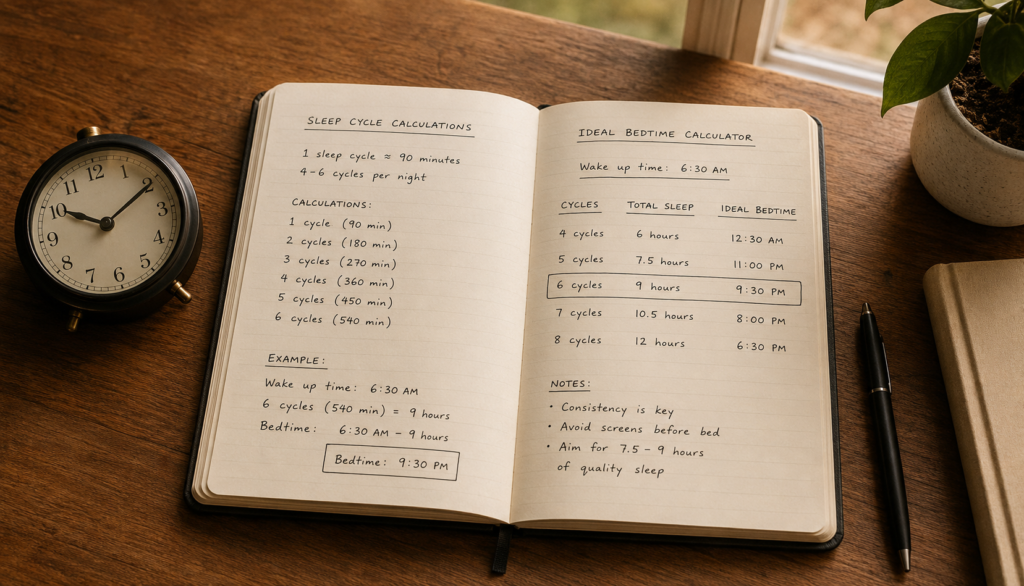
Sleep cycles last approximately 90 minutes on average, moving through stage 1 light sleep, stage 2 light sleep, stage 3 slow wave sleep, and REM sleep before cycling back toward lighter stages and beginning again. Across a typical night, adults complete four to six of these cycles, with the composition of each cycle shifting as the night progresses — earlier cycles are deep-sleep-heavy, later cycles are REM-heavy. Waking at the natural transition point between cycles, where the brain briefly surfaces into lighter sleep before either beginning a new cycle or transitioning to wakefulness, produces noticeably clearer and less groggy waking than being interrupted mid-cycle during deep sleep or REM.
This is the mechanism behind our Sleep Cycle Calculator: rather than targeting an arbitrary total hours number, it targets a total duration that represents a specific number of complete cycles and lands your anticipated wake time at a natural cycle transition.
For most adults, this means aiming for durations of approximately 6 hours, 7.5 hours, or 9 hours — representing four, five, or six complete 90-minute cycles respectively — rather than anchoring to exactly 8 hours, which falls in the middle of a cycle for someone with standard cycle timing and produces a worse average waking experience than either 7.5 or 9 hours would.
What surprised me when I first applied this calculation consistently was how reliably a 7.5-hour night produced better waking clarity than an 8-hour night, despite being shorter. The 30 fewer minutes weren’t what mattered — what mattered was landing the wake time at a cycle boundary rather than mid-cycle. For someone whose actual sleep need sits at 7.5 hours anyway, the 8-hour target was simultaneously setting an incorrect duration goal and producing worse average waking experience by consistently landing them mid-cycle.
Accounting for Sleep Onset Latency in Your Calculation
The most common error in sleep calculation is starting the cycle count from the moment you get into bed rather than from the moment you actually fall asleep. Sleep onset latency — the time between lying down and reaching actual sleep — varies meaningfully between individuals and even for the same person across different nights, typically ranging from 5 to 20 minutes for healthy sleepers. For someone who takes 15 minutes to fall asleep, a bedtime calculation that ignores this will consistently land their wake time 15 minutes into a new cycle rather than at the end of a completed one, producing worse average waking experience than the calculation intended.
Accounting for sleep onset latency in the calculation is straightforward: add your typical falling-asleep time to the cycle duration before subtracting from your target wake time. For someone with a 15-minute typical sleep onset latency who wants to complete five full cycles for 7.5 hours of sleep, the calculation becomes 7.5 hours plus 15 minutes, giving a bedtime 7 hours and 45 minutes before the target wake time rather than exactly 7.5 hours before it. This adjustment, while small, consistently improves the accuracy of cycle-based sleep timing by accounting for the actual start point of the sleep period rather than the start point of time in bed.
Sleep onset latency itself is worth monitoring as an indicator of sleep health beyond its role in calculation accuracy. Consistently taking more than 30 minutes to fall asleep suggests either insufficient homeostatic sleep drive at bedtime — from napping too late, an irregular schedule, or going to bed before genuine sleepiness — or elevated arousal from stress or anxiety that’s preventing the transition into sleep. Both scenarios affect not just calculation accuracy but the underlying quality of the sleep that follows, making persistently long sleep onset latency a signal worth investigating rather than simply adjusting for in the math.
Calculating Sleep Debt and Understanding the Recovery Equation
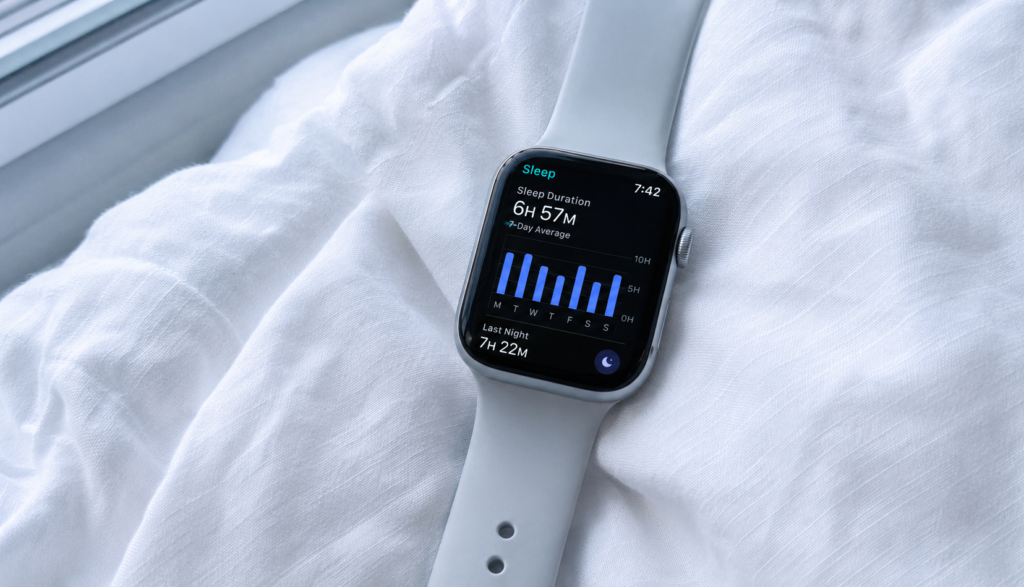
Sleep debt — the accumulated deficit between the sleep you’ve gotten and the sleep your body needed — requires a different kind of calculation than single-night cycle timing, and it’s a calculation most people never make explicitly despite its significant impact on how they feel day to day. The basic sleep debt calculation starts with how many hours of sleep you actually need — typically between 7 and 9 hours for adults, with your specific number identified through alarm-free observation — and subtracts the sleep actually obtained each night, summing the nightly deficits across a week or longer to produce the accumulated total.
A person whose sleep need is 8 hours but who consistently sleeps 6.5 hours accumulates 1.5 hours of sleep debt per night — 10.5 hours per week — that doesn’t simply evaporate on its own. Sleep debt recovery doesn’t follow a clean one-for-one relationship where an extra hour of sleep perfectly repays an hour of debt, but research on sleep debt recovery suggests that consistent adequate sleep over days to weeks gradually clears the deficit, with the most rapid recovery occurring during the first few nights of adequate sleep when the homeostatic sleep drive is at its highest and slow wave sleep rebounds strongly. Running this calculation explicitly — rather than having a vague sense of being tired — gives a concrete picture of how significant the accumulated deficit actually is and how much recovery time is genuinely needed.
From experience tracking this over extended periods, the sleep debt calculation is most useful not as a precise number to obsess over but as a directional indicator — is the debt growing week over week, stable, or declining? A growing debt means current sleep habits are insufficient for sleep needs regardless of how functional days feel, and the subjective adaptation to that insufficiency makes the felt experience an unreliable guide. A stable or declining debt means current habits are meeting or exceeding the need, and any persistent fatigue may have causes other than inadequate sleep duration.
What Most People Don’t Know: Sleep Calculators Have a Precision Limit
Here’s something that matters for applying sleep calculator results appropriately: sleep cycle length for any individual varies meaningfully from the 90-minute average that calculators use, and varies further across different nights for the same person depending on sleep debt, stress, alcohol, and other factors. The 90-minute figure is a population average with individual variation ranging roughly from 70 to 120 minutes — meaning a person whose cycles naturally run 80 minutes will find that “7.5 hours” lands them consistently mid-cycle rather than at a transition, while someone with 100-minute cycles needs a different duration than the standard cycle math suggests.
This precision limit means that sleep calculator outputs should be treated as starting estimates to be refined through personal observation rather than exact prescriptions to follow without adjustment. The most useful way to apply a sleep calculator is to use its outputs as candidate bedtimes, track how waking actually feels at different calculated sleep durations for a week or two each, and identify which duration consistently produces the clearest morning experience for your specific cycle length. This individual calibration step, combining the calculator’s cycle math with your personal data, produces a genuinely personalized optimal sleep duration that the calculator’s population-average assumption alone cannot provide.
Consumer sleep trackers that estimate sleep stages add a useful layer to this calibration by showing whether your actual sleep architecture is matching what the cycle math would predict — whether deep sleep and REM are distributed across the night as expected, whether cycle boundaries appear where the calculator assumes they should, and whether any consistent pattern suggests your cycle length differs significantly from the 90-minute average. Combining calculator estimates with tracker data over several weeks gives the most accurate and individually relevant sleep calculation picture available outside of a clinical sleep laboratory.
Building a Practical Sleep Calculation Routine
A practical sleep calculation routine starts with three inputs: your individual sleep need in hours, your typical sleep onset latency in minutes, and your required or preferred wake time. From these, the calculation works as follows — multiply your target number of sleep cycles by 90 minutes to get your total sleep time target, add your sleep onset latency to account for the falling-asleep period, then subtract the total from your wake time to arrive at the cycle-aligned bedtime. For a person with a 7.5-hour sleep need, 15-minute sleep onset latency, and a 7am required wake time: five cycles of 90 minutes equals 450 minutes of sleep, plus 15 minutes onset latency equals 465 minutes total, which places bedtime at 11:15pm rather than 11:30pm — a small but meaningful difference in cycle alignment.
Running this through our Sleep Estimator rather than manually produces the same result with less friction and allows easy adjustment for different wake times on different days without recalculating from scratch each time.
The calculation also immediately shows which bedtime adjustments are available within a realistic range — if 11:15pm isn’t achievable on a given night, the next cycle-aligned option would be 12:45am for a four-cycle 6-hour night, allowing an informed choice about the tradeoff between cycle alignment and total sleep duration rather than simply splitting the difference at an arbitrary time.
Tracking the results of this calculation over two to four weeks — noting both the calculated sleep parameters and the subjective quality of waking each morning — gives you the calibration data needed to identify whether the population-average 90-minute cycle assumption is accurate for your specific biology or whether your personal cycle length requires an adjustment to the baseline. If calculating and optimizing your sleep schedule produces no improvement in waking experience or daytime function despite consistent application, a doctor or sleep specialist is worth consulting to rule out underlying sleep architecture problems that calculation alone cannot address.
FAQ: Calculating Sleep

A: Multiply your target number of sleep cycles by 90 minutes to get total sleep time, add your typical sleep onset latency, then subtract the total from your target wake time to find your cycle-aligned bedtime. For five cycles: 5 × 90 = 450 minutes of sleep, plus individual sleep onset latency, subtracted from wake time.
A: Most adults need four to six complete sleep cycles per night, corresponding to approximately 6, 7.5, or 9 hours of actual sleep. The right number depends on your individual sleep need — identified through alarm-free observation of your natural sleep duration — rather than a universal target.
A: For people with standard 90-minute cycle timing, 7.5 hours represents five complete cycles while 8 hours falls mid-cycle, producing more sleep inertia and grogginess at the wake time. Whether 7.5 hours is better than 8 hours for any specific person depends on their individual cycle length and sleep need.
A: Sleep onset latency is the time between getting into bed and actually falling asleep, typically 5 to 20 minutes for healthy sleepers. Ignoring it in sleep calculations systematically places the wake time mid-cycle rather than at a transition, degrading waking quality compared to what the calculation intended to produce.
A: Sleep calculators provide useful starting estimates based on a population-average 90-minute cycle, but individual cycle lengths vary from roughly 70 to 120 minutes, meaning calculator outputs need personal calibration through two to four weeks of tracking waking experience at different calculated durations to identify the most accurate timing for a specific individual.
A: Subtract the sleep actually obtained each night from your individual sleep need, then sum these nightly deficits across a week or longer. A person needing 8 hours who consistently sleeps 6.5 hours accumulates 1.5 hours of debt per night, or 10.5 hours per week — a deficit that requires consistent adequate sleep over days to weeks to meaningfully recover.
Calculate Smarter, Not Just Longer
Calculating sleep by hours alone answers the wrong question. The right questions are whether your hours align with complete sleep cycles, whether your bedtime accounts for actual sleep onset rather than time in bed, and whether your total sleep duration is meeting your individual need or slowly accumulating debt. A sleep calculator built on cycle math gives you the framework to answer all three — and once you’ve calibrated its outputs to your personal cycle length through a few weeks of tracking, it produces a bedtime target that’s genuinely yours rather than borrowed from a population average that may or may not reflect your biology.