
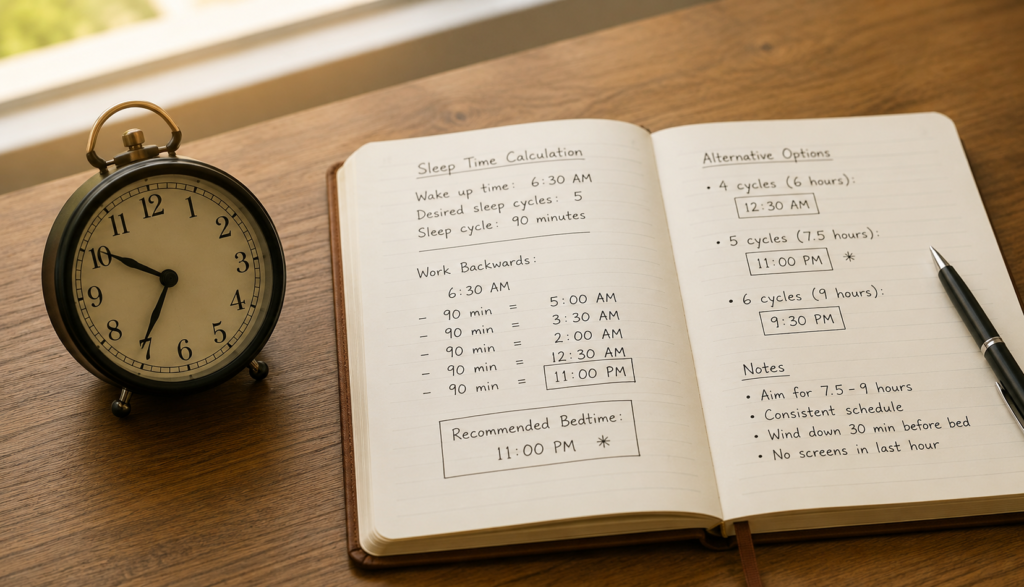
A sleep estimator is a tool that calculates optimal bedtimes and wake times based on sleep cycle timing rather than simply counting hours from one point to another. The distinction matters more than it might initially seem — two people sleeping identical hours can have dramatically different morning experiences depending on whether their wake time falls at a natural cycle transition or mid-deep-sleep, and a sleep estimator built on cycle math is specifically designed to improve that landing point rather than just track total duration.
The appeal of a sleep estimator over informal sleep tracking is precision around a variable that raw hour-counting ignores entirely. When someone says they got seven hours of sleep, they’ve said nothing about whether those seven hours contained four complete cycles landing cleanly at a transition, or whether they woke mid-cycle into the sleep inertia that makes otherwise adequate sleep feel worse than it should. A cycle-based sleep estimator makes that distinction explicit and turns it into an actionable recommendation rather than a retrospective observation.
I’ve used sleep estimation frameworks consistently enough to have a clear picture of where they add genuine value, where they have inherent limitations, and how to apply them in a way that produces real improvements in sleep quality rather than theoretical ones. The tool is useful — but like any tool, it produces better outcomes when you understand both its mechanism and its limits.
How a Sleep Estimator Works
The foundation of any sleep estimator is understanding how long a sleep cycle actually runs — roughly 90 minutes through a sequence of NREM and REM sleep stages that repeats throughout the night. A sleep estimator uses this cycle length as its primary unit, calculating bedtimes and wake times that represent multiples of complete cycles rather than arbitrary hour counts.
Our Bedtime Calculator works in both directions: given a target wake time, it identifies the bedtimes that would produce two, three, four, five, or six complete cycles before that wake time — giving you a menu of cycle-aligned options at different total durations.
Given a target bedtime, it identifies the wake times that follow complete cycle sequences, again producing a menu rather than a single answer.
The sleep onset latency adjustment is the refinement that separates a well-designed sleep estimator from a simple multiplication table. Since cycles begin from the moment of actual sleep onset rather than from getting into bed, an estimator that adds a buffer for the falling-asleep period — typically 10 to 20 minutes as a default, adjustable to individual estimates — systematically improves cycle alignment compared to an estimator that starts the cycle count from the moment you lie down. This buffer accounts for the real gap between entering the sleep environment and beginning the first cycle, ensuring the wake time recommendation reflects genuine cycle completion rather than a calculation that starts several minutes too early.
Most people overlook this completely: a sleep estimator’s output is a probability distribution, not a precise guarantee. Because individual cycle lengths vary around the 90-minute average — some people run 80-minute cycles, others run 100-minute cycles, and any given night can vary from a person’s personal average depending on sleep debt, stress, and other factors — the estimator’s recommendations are cycle-aligned starting points to be tested and refined rather than exact prescriptions. The estimator gets you into the right neighborhood of cycle transitions; personal calibration through a few weeks of observation gets you to the precise address.
What a Sleep Estimator Can and Cannot Tell You
A sleep estimator reliably tells you which bedtimes and wake times are likely to land near cycle transition points given standard 90-minute cycle timing and your specified sleep onset latency. It tells you how many complete cycles fit within different total durations, making tradeoffs between total sleep and cycle alignment visible rather than hidden. It gives you a structured framework for approaching sleep duration decisions rather than defaulting to “as many hours as possible” or “whatever allows me to function minimally,” both of which ignore the architectural dimension of sleep quality entirely.
What a sleep estimator cannot tell you is whether you’re getting adequate deep sleep within those cycles, whether your sleep architecture is fragmented by factors it can’t observe, or whether your individual cycle length matches the 90-minute assumption closely enough for its recommendations to be accurate without personal calibration. These limitations don’t undermine the tool’s value — they define the appropriate role it plays alongside other sleep quality indicators rather than as a standalone measure of sleep adequacy.
The most common misapplication of sleep estimator results is using cycle math to justify shorter total sleep duration — concluding that six hours timed to cycle boundaries is equivalent to eight hours of sleep because the waking experience feels somewhat better at the cycle transition. The estimator improves the subjective experience of waking from a given duration; it doesn’t change the cumulative restorative value of that duration relative to a longer night. Cycle-aligned six hours is better than non-aligned six hours, but it is not equivalent to cycle-aligned seven and a half hours for a person whose sleep need genuinely sits at seven and a half hours. Total sleep duration and cycle alignment are both important — they’re not substitutes for each other.
Estimating Your Individual Sleep Need Alongside Cycle Timing
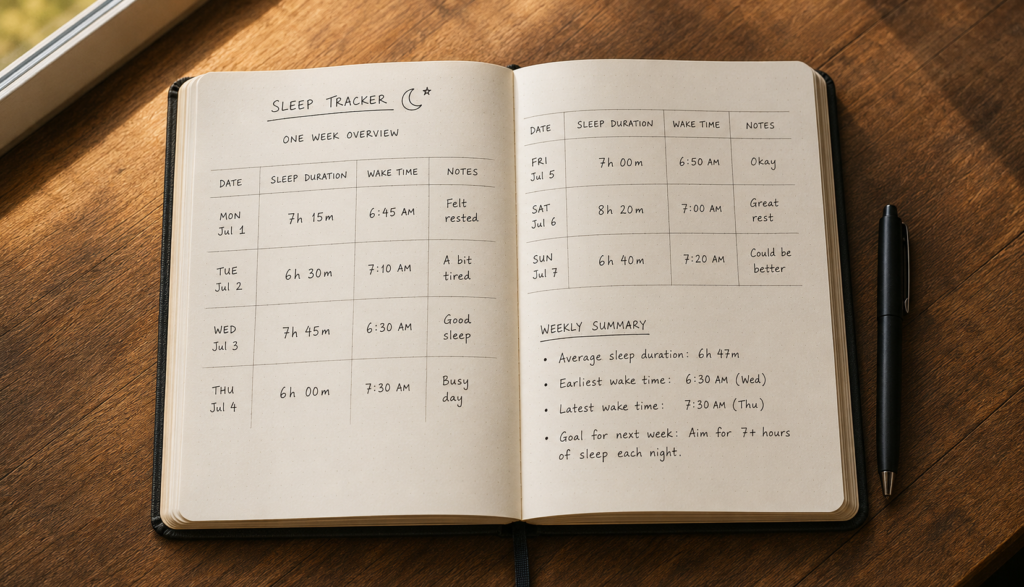
A sleep estimator produces its most accurate and useful results when paired with an accurate estimate of individual sleep need, rather than defaulting to a universal eight-hour assumption. Individual sleep need — the duration at which the body fully clears its homeostatic sleep drive each night and wakes genuinely rested without accumulated debt — varies meaningfully between adults in the 7 to 9 hour range, and feeding an incorrect sleep need into the estimation framework produces recommendations that are cycle-aligned but still chronically insufficient or unnecessarily excessive depending on the direction of the error.
Estimating individual sleep need most accurately requires removing external time pressure — no alarms, no obligations — for at least a week and observing what duration the body naturally settles into once existing sleep debt has been cleared. The first few nights of this observation period typically involve longer sleep as debt clears, with duration stabilizing at a consistent baseline in the latter part of the week. That stabilized baseline, averaged across the final three or four days, represents the closest available estimate of genuine individual sleep need without clinical measurement. Feeding this number into the sleep estimator rather than the conventional eight-hour default produces bedtime and wake time recommendations that are simultaneously cycle-aligned and duration-appropriate for the individual’s actual biology.
From experience running this combined assessment, the most common finding is that individual sleep need differs from the assumed eight hours in both directions — some people discover their need sits at 7 hours flat, making the eight-hour target unnecessarily long and leaving them lying in bed awake after natural waking for a final cycle they don’t need. Others discover their need is closer to nine hours, and the seven or eight hours they’ve been targeting has been accumulating debt the entire time regardless of how they’ve felt during the brief subjective adaptation to that level. Both findings are actionable: the estimator can then be calibrated to the actual need rather than the assumed one.
What Most People Don’t Know: Estimating Sleep Quality Alongside Duration
Here’s something that extends the sleep estimator concept beyond its standard application: the most complete picture of sleep adequacy requires estimating not just duration and cycle alignment but sleep quality within those cycles, because identical cycle counts with different internal compositions produce meaningfully different restorative outcomes. A night of five cycles where deep sleep was suppressed by alcohol or fragmented by sleep apnea is not equivalent in restorative value to five cycles with intact slow wave sleep architecture, even though both would appear identical in a duration-and-cycle-count estimation.
Consumer sleep trackers that estimate sleep stage percentages add this missing dimension to what a pure sleep estimator provides. The combination of cycle-based duration estimation — telling you when to sleep for optimal cycle alignment — and sleep stage tracking — telling you whether the sleep inside those cycles had the architecture it needed — gives a more complete picture of sleep adequacy than either tool provides alone. The estimator handles the scheduling dimension; the tracker handles the quality dimension within that schedule. Together they answer both the quantity and quality questions that determine whether sleep is genuinely restorative or just technically present for the right number of hours.
The cortisol awakening response adds a third estimation dimension that’s worth understanding: the quality of the first hour after waking is partly determined by how well the circadian rhythm has calibrated to the consistent wake time produced by the estimator’s schedule. An estimator recommendation followed inconsistently — applied some nights and ignored others — produces weaker circadian calibration and a less robust awakening response than the same recommendation applied consistently across all seven days. The estimator produces its best results not as a nightly calculation but as a consistent schedule maintained long enough for the circadian system to calibrate to the pattern it produces.
Applying Sleep Estimation Practically
The practical application of a sleep estimator starts with three inputs that also determine what time you should go to bed: your required wake time on a given day or across a week, your estimated individual sleep need in hours, and your typical sleep onset latency in minutes.
From these, the estimator identifies the cycle-aligned bedtime closest to allowing your full sleep need before your wake time. If that bedtime isn’t achievable on a given night, the next cycle-aligned option earlier in the evening — sacrificing one cycle for an earlier bedtime — or the next option later — accepting later waking if the schedule allows — gives you an informed choice about the available tradeoffs.
Running this estimation consistently for two to four weeks, and tracking subjective waking quality at different recommended durations during that period, gives you the calibration data needed to refine the estimator’s outputs for your personal cycle length. If the recommended seven-and-a-half-hour target consistently produces worse waking than six hours, your personal cycle length may run slightly shorter than 90 minutes and the six-hour recommendation is actually landing at a better cycle transition for you than the calculator’s seven-and-a-half-hour estimate. If neither produces clean waking, the issue likely lies in sleep quality rather than cycle timing — fragmentation from sleep apnea, temperature, or other architectural disruptions that no timing optimization can resolve.
Using the sleep estimator in combination with morning alertness tracking — a simple daily rating of how rested and alert you felt upon waking, noted before caffeine — builds a dataset that reveals which combinations of duration and timing actually produce your best mornings rather than which ones the population-average math suggests should. That personal dataset is the most accurate sleep estimator available for any specific individual, because it incorporates the individual cycle length variation, sleep onset latency, and architectural factors that no population-average tool can account for without measurement. If persistent poor sleep quality despite optimized timing suggests an underlying issue, a doctor or sleep specialist is always worth consulting to rule out conditions that estimation and scheduling alone cannot address.
FAQ: Sleep Estimator

A: A sleep estimator is a tool that calculates optimal bedtimes and wake times based on sleep cycle timing — typically 90-minute cycles — rather than simply counting total hours. It identifies the bedtimes and wake times that represent complete cycle multiples, improving the probability of waking at a natural sleep cycle transition rather than mid-deep-sleep or mid-REM.
A: Sleep estimators provide useful starting estimates based on a population-average 90-minute cycle, but individual cycle lengths vary from roughly 70 to 120 minutes. This means estimator outputs need personal calibration through two to four weeks of tracking waking experience at different recommended durations to identify the most accurate timing for a specific individual.
A: A well-designed sleep estimator needs three inputs — your required wake time, your estimated individual sleep need in hours, and your typical sleep onset latency in minutes. The onset latency adjustment accounts for the time between getting into bed and actually falling asleep, improving cycle alignment accuracy compared to estimators that start the count from bedtime.
A: Yes, for most people — landing the wake time at a natural sleep cycle transition rather than mid-cycle reduces sleep inertia and produces clearer morning waking. The improvement is most noticeable for people who currently wake at arbitrary times unrelated to cycle boundaries. The estimator improves waking experience within a given duration but doesn’t increase the restorative value of that duration itself.
A: Using a sleep estimator to establish a consistent bedtime based on your fixed wake time and calibrated sleep need produces better results than recalculating nightly. Once the cycle-aligned schedule is established and calibrated, maintaining it consistently across all seven days allows the circadian rhythm to calibrate its awakening response, improving morning alertness beyond what the cycle timing alone produces.
A: Sleep onset latency is the time between getting into bed and actually falling asleep — typically 5 to 20 minutes for healthy sleepers. A sleep estimator needs this figure because sleep cycles begin from actual sleep onset, not from bedtime. Ignoring onset latency systematically places wake times mid-cycle rather than at transitions, producing worse average waking experience than the estimator intends.
A: Standard sleep estimators calculate duration and cycle alignment but don’t account for sleep quality within cycles. A complete sleep picture requires combining estimator outputs with sleep stage tracking from a consumer tracker to assess whether deep sleep and REM sleep are occurring with adequate depth and duration inside the cycles the estimator has timed.
Estimate Smarter, Then Calibrate to Yourself
A sleep estimator gives you a better starting point than arbitrary hour-counting by building cycle timing into the calculation from the start. Use it to identify your cycle-aligned bedtime, apply it consistently enough for your circadian rhythm to calibrate, and track your actual morning experience across several weeks to refine the population-average outputs to your personal cycle length. The tool does the initial math; you supply the individual data that makes the estimate accurate for your specific biology rather than just statistically reasonable for the average person.