

A sleep schedule that exists only in intention — the vague plan to go to bed earlier and wake up feeling better — is one of the most common and least effective approaches to fixing a sleep schedule.
Most people have tried this version at some point, noticed modest improvement for a few days, and watched it gradually dissolve back into reactively-timed sleep within a week or two. The version that actually sticks is built differently — not from aspiration but from calculation, not from a single bedtime target but from a structured framework that accounts for wake time, sleep cycle length, individual sleep need, and the chronotype factors that determine when sleep onset is biologically feasible rather than just theoretically scheduled.
A sleep schedule maker — whether a tool, a calculator, or the manual process of building one yourself — produces a specific, personalized bedtime and wake time pair that’s grounded in how sleep actually works rather than in what sounds like a reasonable number of hours. The difference between a schedule built this way and one built by intuition is the difference between targeting a cycle-aligned sleep window that accounts for your biology and targeting an arbitrary duration that sounds adequate without knowing whether it actually is for you specifically.
I’ve built and tested sleep schedules across extended periods using both intuitive and calculated approaches, and the calculated version consistently produces better outcomes — both in initial sleep quality improvement and in how long the schedule actually holds before reverting to old patterns. The reason it sticks better isn’t discipline — it’s that a schedule built on accurate inputs gives the circadian system the stable anchor it needs to calibrate, which makes maintaining the schedule progressively easier rather than harder over time.
Step One: Anchor the Wake Time Before Anything Else
Every effective sleep schedule starts with the wake time rather than the bedtime, because wake time is the primary anchor of the circadian rhythm and the fixed constraint around which everything else is calculated. The homeostatic sleep drive, cortisol awakening response, melatonin timing, and core body temperature rhythm all calibrate to the expected wake time — not the bedtime — which means the wake time is the variable that most directly shapes the circadian system’s daily pattern. A consistent wake time maintained across all seven days, including weekends, gives the circadian clock the stable reference point it needs to time its preparation sequence accurately.
Selecting the wake time means identifying the earliest time that a realistic, non-emergency obligation requires you to be functional — not the time you technically need to leave the house, but the time at which you need to be genuinely alert and capable of performing whatever the morning requires. For most working adults this falls somewhere between 5:30am and 8am depending on commute, family obligations, and work start times. This required wake time becomes the fixed anchor of the schedule; the bedtime is then derived from it rather than chosen independently.
The most common schedule-building mistake is choosing both a bedtime and a wake time independently and hoping they add up to enough sleep. They frequently don’t, or they add up to the right number of hours in theory while landing the wake time mid-cycle in a way that produces unnecessary grogginess every morning. Anchoring the wake time first and deriving the bedtime from it removes this inconsistency by making the relationship between the two explicit and mathematically grounded rather than approximate and intuitive.
Step Two: Calculate the Cycle-Aligned Bedtime
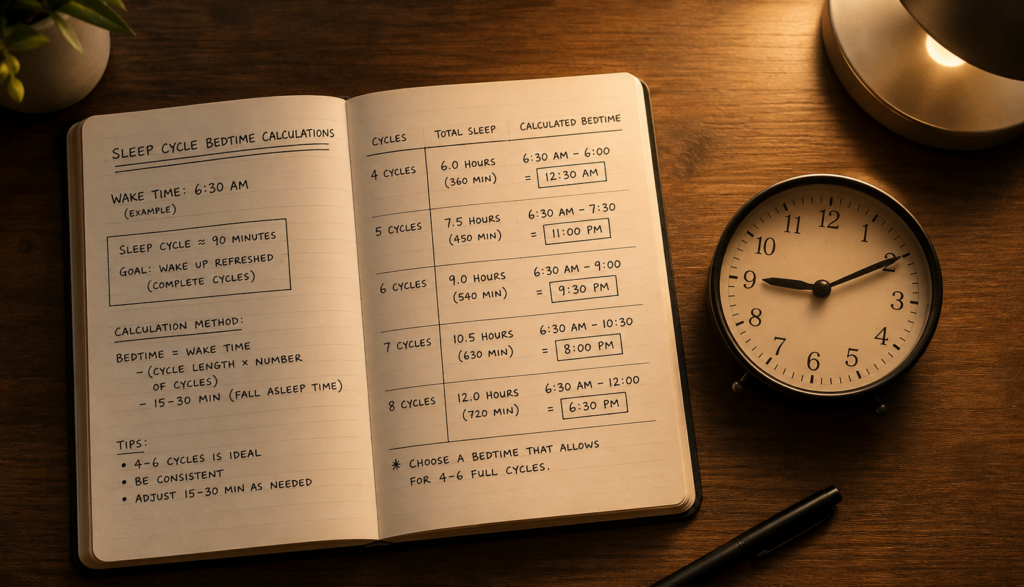
With the wake time established, the bedtime calculation works backward through cycle-aligned sleep durations to identify the bedtimes that give the highest probability of landing the wake time near a natural cycle transition. The standard unit is 90 minutes per cycle, producing cycle-aligned total durations of 6 hours for four cycles, 7.5 hours for five cycles, and 9 hours for six cycles. Subtracting each of these from the target wake time gives a menu of candidate bedtimes — each representing a different total sleep duration but all sharing the property of being cycle-aligned rather than landing the wake time mid-cycle.
Adding the sleep onset latency buffer — typically 10 to 20 minutes, adjusted to individual experience of how long falling asleep actually takes — shifts each candidate bedtime slightly earlier to account for the time between getting into bed and actual sleep onset. For a 6:30am wake time with a 15-minute onset buffer, the cycle-aligned bedtime menu becomes approximately 10:45pm for five cycles at 7.5 hours, 9:15pm for six cycles at 9 hours, and 12:15am for four cycles at 6 hours. The five-cycle option at 7.5 hours is typically the primary target for most adults; the four-cycle option serves as a fallback on constrained nights, and the six-cycle option supports active sleep debt recovery periods.
Running this calculation through our Sleep Schedule Maker rather than manually produces the same menu of options with less friction and allows easy adjustment whenever the wake time changes — a different schedule on certain days, travel, or seasonal shifts in obligation timing.
The calculator makes the tradeoffs between different duration and alignment options visible and concrete, producing an informed choice about the available options rather than a guess about which bedtime might work.
Step Three: Adjust for Chronotype
The cycle-aligned bedtime produced by the calculation above assumes average chronotype timing — a melatonin production schedule and circadian phase that matches the population middle. For people who are meaningfully earlier or later than average in their circadian timing, the calculated bedtime needs adjustment to reflect when sleep onset is actually biologically feasible rather than just arithmetically timed.
Morning chronotypes whose melatonin rises earlier than average will often find the calculated bedtime already falls within their comfortable sleep-ready window or even slightly later than their natural preference, making the schedule straightforward to implement. Evening chronotypes whose melatonin production doesn’t begin rising until 11pm or midnight will find calculated bedtimes before that point produce extended wakefulness rather than sleep onset — the schedule looks correct on paper but fails in practice because the biology isn’t ready at the calculated time.
For evening chronotypes working within fixed early wake time constraints, the honest adjustment is to shift the target bedtime later to match actual sleep readiness, accept that this may mean targeting four cycles of cycle-aligned sleep on constrained nights rather than five, and use morning light exposure and evening light reduction consistently to gradually advance the circadian phase over weeks toward the earlier target. The first time I applied this chronotype adjustment to a schedule I’d been building for an evening-type friend who couldn’t fall asleep at the calculated bedtime no matter how consistently they tried, shifting the target 45 minutes later to match their actual melatonin timing made the difference between a schedule that worked immediately and one that had been failing for months.
What Most People Don’t Know: A Sleep Schedule Has a Break-In Period
Here’s something that determines whether a new sleep schedule sticks or dissolves within two weeks: the circadian rhythm needs approximately two to three weeks of consistent schedule exposure before it fully calibrates its preparation sequences to the new timing. During the break-in period, mornings often feel harder than expected even when the schedule is technically correct, because the cortisol awakening response hasn’t yet fully timed itself to the new wake time, and the melatonin and temperature rhythms are still partially anchored to the previous schedule. This break-in difficulty is not a sign that the schedule is wrong — it’s the expected physiological response to circadian recalibration, and pushing through it consistently is what produces the dramatically easier mornings that emerge on the other side of full calibration.
People who abandon new sleep schedules during the break-in period because mornings feel worse than before are making a timing error rather than a schedule error — the same kind of misread that keeps people stuck longer in insomnia than necessary.
The first week of a new schedule is almost always the hardest — sleep onset may take longer than the onset buffer assumed because the circadian phase hasn’t fully shifted, and morning alertness may lag because the cortisol response hasn’t calibrated yet. The second week typically improves noticeably, and by the third week most people find the schedule feels significantly more natural and sustainable than the first week suggested it would.
Sleep debt also interacts with the break-in period in a way that complicates the initial experience. If a new schedule is meaningfully earlier than the previous pattern — a common scenario for someone trying to fix a drifted sleep schedule — the first several days produce some additional tiredness as the body pays down accumulated debt from the shift. This tiredness is real but temporary, and interpreting it as evidence that the schedule is too ambitious leads to reverting to the old pattern before the recalibration process has had enough time to demonstrate its benefits.
Building the Supporting Habits That Make the Schedule Hold
A sleep schedule exists on paper, but it runs on habits. The bedtime calculation gives you the target; the evening and morning habits are what make hitting that target consistently achievable rather than aspirational. Evening light management — reducing blue light exposure from screens in the two hours before the target bedtime — supports the melatonin production timing that makes falling asleep at the calculated bedtime physiologically feasible rather than something that requires fighting the biology to achieve. Morning light exposure — bright natural light within the first 15 to 30 minutes of the target wake time — reinforces the circadian anchor that the consistent wake time is trying to establish, strengthening the calibration that makes subsequent days easier.
Caffeine timing deserves specific mention in the context of sleep schedule adherence because its half-life of five to seven hours means afternoon consumption directly affects sleep onset at most calculated bedtimes. A person targeting a 10:45pm bedtime who consumes caffeine at 3pm still has roughly half the stimulant load active at bedtime, extending sleep onset beyond the assumed buffer and pushing the actual first cycle start later than the schedule calculated. Moving caffeine cutoff to early afternoon — no later than 1pm to 2pm for most people — removes this variable from the sleep onset equation and makes the onset latency assumption in the calculation more accurate rather than systematically optimistic.
Tracking compliance and outcomes for the first month of a new schedule — noting actual bedtime, actual wake time, and a simple morning alertness rating before caffeine — provides the data needed to refine the schedule based on real results rather than maintaining the initial calculation unchanged regardless of what it’s producing. If the calculated bedtime consistently produces sleep onset 30 minutes later than assumed, the onset buffer needs adjustment. If the cycle-aligned wake time still produces significant sleep inertia, personal cycle length may differ from the 90-minute average and the calculation needs recalibration. If you’re dealing with persistent sleep quality issues that don’t respond to schedule optimization after a full month of consistent effort, a doctor or sleep specialist is always worth consulting to identify whether underlying conditions are preventing the schedule from working as designed.
FAQ: Sleep Schedule Maker

A: Start by fixing your wake time based on your earliest daily obligation, then calculate backward through 90-minute cycle multiples — adding your typical sleep onset latency — to identify cycle-aligned bedtime options. Choose the option that provides your full sleep need, adjust for chronotype if your natural sleep readiness differs from average timing, and hold both times consistently across all seven days.
A: Most people experience noticeable improvement within one to two weeks, with full circadian calibration typically requiring two to three weeks of consistent schedule adherence. The first week is usually the hardest as the circadian rhythm recalibrates — morning alertness and sleep onset ease both improve progressively rather than immediately.
A: Yes — maintaining wake time within roughly 30 minutes across all seven days is the single most important factor for keeping the circadian rhythm calibrated. Weekend shifts of more than an hour create social jet lag that requires readjustment at the start of each week, producing consistently worse Monday and Tuesday mornings than a seven-day consistent schedule would.
A: Sleep cycles of approximately 90 minutes determine which total sleep durations land the wake time at a natural transition point rather than mid-deep-sleep. Cycle-aligned durations — 6, 7.5, or 9 hours — produce consistently better waking experience than arbitrary hour counts, making cycle math a core element of any well-built sleep schedule rather than an optional refinement.
A: Difficulty falling asleep at the calculated bedtime usually indicates one of three things — the bedtime is earlier than your chronotype’s natural sleep onset window, evening light exposure is suppressing melatonin and delaying sleep readiness, or existing sleep debt hasn’t yet accumulated enough pressure to support sleep onset at the new earlier time. Reducing evening light, adjusting the bedtime for chronotype, and avoiding naps to build sleep pressure typically resolve this within the first week.