
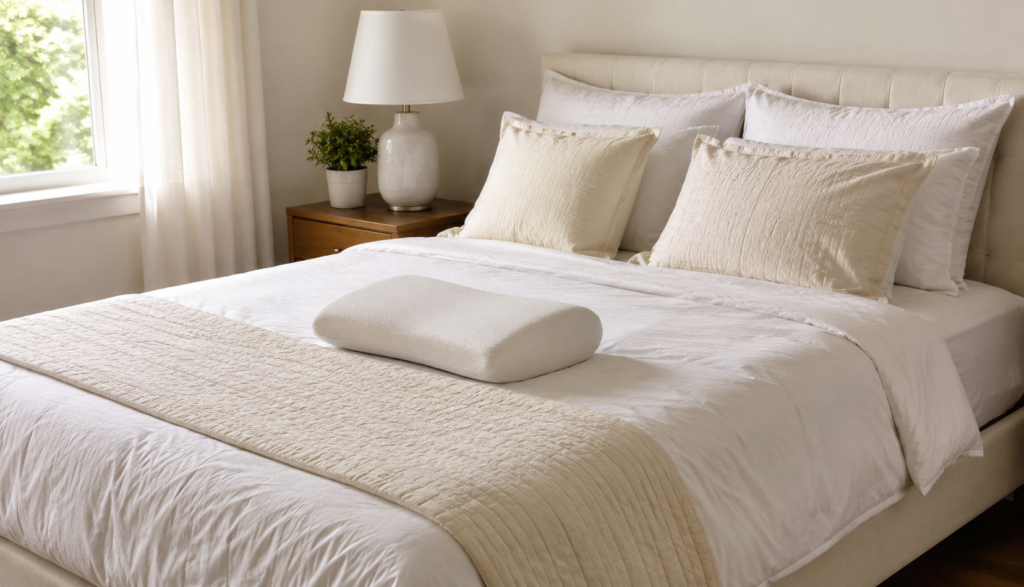
Waking up with lower back pain that wasn’t there before bed is a specific and frustrating experience — the body was supposedly resting, yet somehow the pain is worse than it was the night before. This isn’t random. Sleep position and support directly determine how much mechanical strain the lumbar spine experiences for seven to nine hours each night, and getting that setup wrong compounds existing back pain in ways that getting it right can meaningfully reverse, often faster than people expect.
The lumbar spine has a natural forward curve, and most sleep-related back pain comes down to one core problem — that curve being forced into an unnatural position for hours at a time, either flattened completely against an unsupportive surface or twisted asymmetrically by an unsupported sleep posture. The pain that results isn’t from the position itself in isolation but from the sustained, repeated strain that builds across a full night and accumulates over weeks and months if the underlying setup never changes.
I’ve spent considerable time looking at the physical therapy and orthopedic literature on sleep positioning for back pain because so much generic advice oversimplifies it to “sleep on your side” without addressing the actual support details that determine whether that advice helps or does nothing. The position matters, but the support underneath the position matters just as much, and most people only get the first half of that equation.
Why Lower Back Pain Often Gets Worse Overnight
During the day, your core muscles, postural reflexes, and frequent movement all work together to support the lumbar spine and distribute load away from any single point of strain. At night, that active support disappears almost entirely. Muscles relax progressively as sleep deepens, postural correction stops happening unconsciously, and the spine spends hours in whatever position the mattress and pillows allow — for better or worse — without the muscular compensation that protects it during waking hours. This is precisely why an unsupportive mattress, poor pillow placement, or even the wrong bedroom temperature causes problems at night that wouldn’t register as painful during a few minutes of standing or sitting in the same alignment.
Inflammation follows a circadian pattern that compounds this issue for many people with chronic back pain. Inflammatory markers associated with joint and disc-related pain tend to rise overnight and peak in the early morning hours for a significant portion of people with conditions like degenerative disc disease or inflammatory arthritis affecting the spine. This is part of why morning back pain often feels worse than pain experienced later in the day — it’s not purely about sleep position, though position significantly modulates how much that natural inflammatory peak translates into actual pain and stiffness upon waking.
Disc compression adds another layer specific to back pain during sleep. Spinal discs absorb fluid overnight when not under the compressive load of standing and sitting, which is why people are measurably taller in the morning than at night. This fluid absorption process makes the discs slightly more rigid and less able to absorb shock from awkward positioning during the early morning hours specifically, which is one reason poor sleep posture sometimes produces its most noticeable pain impact closer to waking rather than earlier in the night.
Most people overlook this completely: a single night of poor positioning rarely causes significant pain on its own, but the cumulative effect of months or years of the same unsupported position creates progressive structural strain that eventually crosses into noticeable pain territory. By the time someone notices consistent morning back pain, the underlying positional problem has typically been present for a long time — which means the fix, while effective, often takes more than a single night to produce a noticeable improvement as the accumulated strain gradually resolves.
The Fetal Position and Why It Works for Many Back Pain Cases
The fetal position — lying on your side with knees drawn up toward the chest — is frequently recommended for lower back pain, particularly pain related to herniated discs or sciatica, and the mechanism behind why it helps is specific rather than generic comfort. Curling the knees toward the chest opens the space between vertebrae, which can relieve pressure on a herniated or bulging disc that’s compressing nearby nerve roots, including the sciatic nerve when sciatica is the underlying issue. This position essentially flexes the lumbar spine in a direction that increases the space available for compressed structures rather than further compressing them.
For people with sciatica specifically, the fetal position on the side opposite to the affected leg often provides additional relief because it can reduce direct pressure on the irritated nerve root from that side. This isn’t universal — some people with sciatica find more relief from positions that extend rather than flex the spine, depending on the specific underlying cause of nerve compression, which is part of why self-experimentation with positioning, ideally guided by feedback from a physical therapist who understands your specific diagnosis, tends to outperform generic positional advice applied without testing.
The fetal position does carry a tradeoff worth knowing about — extended time in significant spinal flexion, if maintained too rigidly or for people whose pain isn’t disc-related, can occasionally contribute to stiffness in a different way by limiting the spine’s overall range of motion overnight. A moderate version — knees drawn up partially rather than tucked tightly to the chest — tends to provide the disc-relieving benefit without the stiffness tradeoff that a more extreme curl can produce over a full night for some people.
Back Sleeping With Proper Support for Lumbar-Dominant Pain
For people whose back pain is more related to general lumbar strain or muscular tension rather than a specific disc or nerve compression issue, back sleeping with proper knee support frequently provides excellent results because it allows the spine to rest in a neutral, evenly distributed position rather than the side-bending and rotation that side sleeping inevitably introduces, even with good support. A pillow placed under the knees when sleeping on the back is the single most important addition for back pain specifically — it tilts the pelvis slightly and allows the lumbar spine’s natural curve to remain supported rather than flattening completely against the mattress, which is the most common mechanism by which unsupported back sleeping worsens lower back pain rather than helping it.
The height and firmness of the knee support pillow matters more than people typically expect. Too low and it provides minimal pelvic tilt benefit. Too high and it can actually increase strain by overly flexing the hips in a way that pulls on the lower back from the opposite direction. A medium-height, moderately firm pillow or wedge specifically designed for under-knee support during back sleeping tends to produce the most consistent relief across different body types and existing pain patterns.
From experience reviewing physical therapy guidance on this specific setup, people who add proper knee support to back sleeping for the first time frequently report a noticeable reduction in morning stiffness within the first few nights, even before any other change. This is one of the higher-impact, lowest-effort adjustments available for lumbar-dominant back pain because it directly addresses the lumbar flattening mechanism without requiring a full position change for people who already prefer or tolerate back sleeping.
What Most People Don’t Know: Mattress Firmness Affects Pain More Than Position
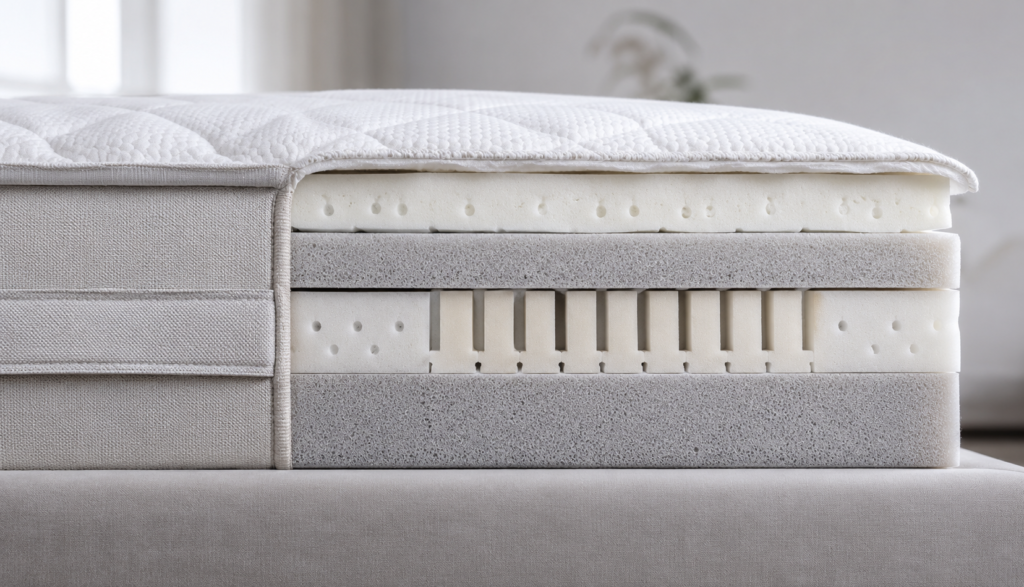
Here’s something that gets underemphasized relative to position advice: research comparing mattress firmness for chronic lower back pain has consistently found that medium-firm mattresses produce better pain outcomes than either very soft or very firm options across most people, and this variable often matters more than which specific sleep position someone uses. A mattress that’s too soft allows excessive sinkage at the hips, creating the same lumbar misalignment problem regardless of whether someone sleeps on their side or back. A mattress that’s too firm doesn’t allow any give at pressure points, creating localized strain that can radiate into generalized back tension over a full night.
The reason this gets overlooked is that position changes feel like an active, controllable intervention people can implement immediately, while mattress replacement feels like a larger investment requiring more deliberation. But people who’ve optimized their sleep position perfectly while sleeping on a mattress that’s significantly too soft or too firm for their body weight and pain pattern often see limited improvement, because the structural problem the mattress creates can override the benefit of correct positioning. This is particularly relevant for people who’ve tried multiple positions without success — the mattress itself may be the unaddressed variable producing pain regardless of how the body is positioned on top of it.
Memory foam and hybrid mattresses with targeted lumbar support zones have shown specific benefit for back pain populations in comparative studies, largely because they can provide firmer support precisely where the lumbar spine needs it while still allowing appropriate give at the shoulders and hips. This zoned support approach addresses both the flattening problem and the pressure point problem simultaneously in a way that a single uniform firmness level often cannot achieve as effectively across an entire body.
Building a Complete Setup for Reducing Back Pain at Night
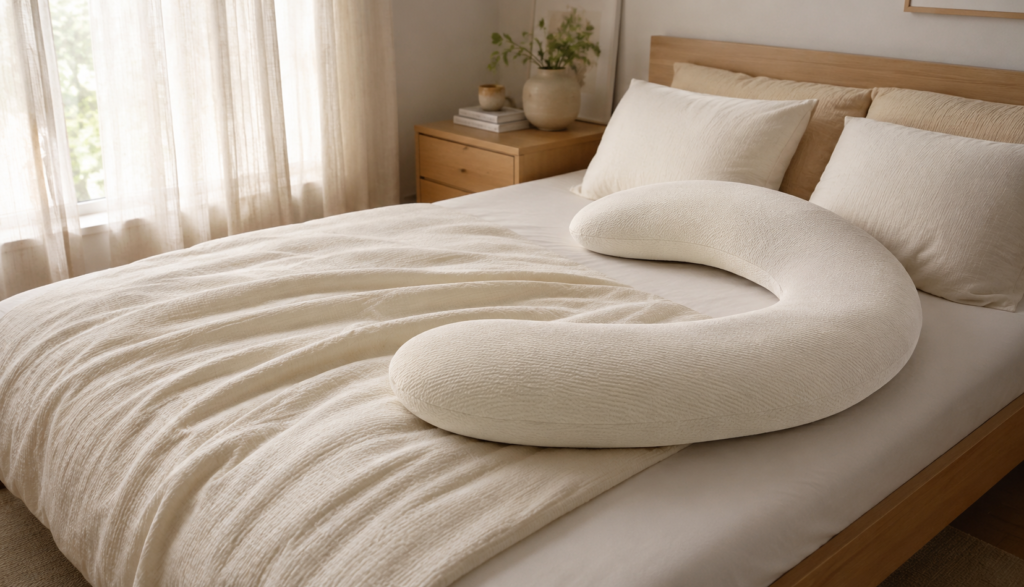
Combining the right position with the right support produces results that neither element achieves alone. For side sleepers with back pain, a body pillow positioned between the knees maintains hip alignment and prevents the top leg from rotating forward, which would otherwise twist the lower back asymmetrically over a full night. For back sleepers, the under-knee pillow discussed earlier paired with a mattress of appropriate firmness addresses the lumbar flattening mechanism directly. For people using the fetal position for disc-related pain, a pillow between the knees serves a similar stabilizing function, preventing the top leg from dropping forward and adding rotational strain on top of the flexion the position is already providing.
Gentle stretching before bed — particularly movements that mobilize the hips and lower back without aggressive force, such as a supported child’s pose or gentle pelvic tilts — paired with our Sleep Timer to build a consistent wind-down routine, can reduce the muscle tension that accumulates throughout the day before it carries into the night’s sleep position.
This doesn’t replace proper positional support but can meaningfully reduce the baseline tension that any position has to work against, making whatever setup you’ve built more effective than it would be on chronically tense muscles.
Ensuring adequate total sleep duration matters more for back pain than most people realize, because sleep deprivation itself is associated with increased pain sensitivity through changes in how the nervous system processes pain signals — meaning insufficient sleep can make existing back pain feel worse independent of any positional factor, creating a compounding cycle where pain disrupts sleep and poor sleep amplifies pain perception.
If lower back pain during sleep persists despite proper positional and mattress adjustments, or if it’s accompanied by numbness, tingling, or weakness in the legs, a doctor or physical therapist is always worth consulting — these symptoms can indicate nerve involvement that requires targeted diagnosis and treatment beyond what sleep positioning alone can resolve, and a professional assessment can identify whether the underlying cause needs intervention beyond night-time setup changes.
Frequently Asked Questions
A: It depends on the cause. The fetal position with knees drawn toward the chest works well for disc-related pain and sciatica by opening space between vertebrae. Back sleeping with a pillow under the knees works best for general lumbar strain by maintaining the spine’s natural curve. Both require proper pillow support to be effective.
A: Spinal discs absorb fluid overnight, becoming slightly more rigid by early morning, and inflammatory markers associated with joint and disc pain tend to peak in the early morning hours for many people. Combined with hours of unsupported positioning, this often makes pain feel worse upon waking than it did the night before.
A: Yes, for back sleepers specifically. A pillow under the knees tilts the pelvis slightly and allows the lumbar spine’s natural curve to remain supported rather than flattening against the mattress, which is one of the most common mechanisms by which unsupported back sleeping worsens lower back pain.
A: Medium-firm mattresses consistently produce better outcomes for chronic lower back pain than very soft or very firm options. Very soft mattresses allow excessive hip sinkage, while very firm mattresses fail to relieve pressure points, both of which can worsen back pain regardless of sleep position.
A: Often yes, particularly lying on the side opposite the affected leg. The position flexes the lumbar spine in a way that opens space between vertebrae, potentially relieving pressure on a compressed nerve root. A moderate curl rather than a tight tuck tends to provide relief without producing additional stiffness.
A: Yes, significantly. A mattress that’s too soft or too firm for your body weight and pain pattern can create lumbar misalignment or pressure point strain regardless of sleep position. People who optimize their sleep position without addressing an unsuitable mattress often see limited improvement in back pain.
A: Generally no. Stomach sleeping flattens the lumbar spine’s natural curve in the opposite direction and forces sustained neck rotation, both of which typically worsen rather than relieve lower back pain. Side sleeping with knee support or back sleeping with proper knee elevation are both better alternatives.
The Setup Matters as Much as the Position

Lower back pain during sleep responds well to the right combination of position and support, but neither alone is usually enough. Identify whether your pain pattern suggests disc or nerve involvement versus general lumbar strain, choose the position that addresses that specific mechanism, and build proper pillow and mattress support around it rather than treating position as the entire solution. Give any new setup a week or two before judging its effectiveness, since accumulated strain takes time to resolve even with the right changes in place.