
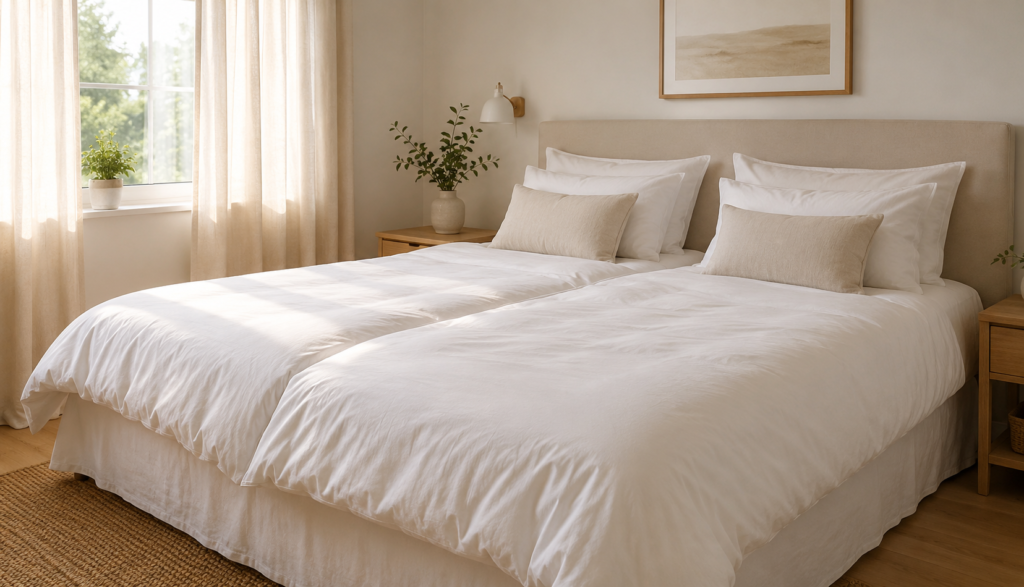
Walk into a hotel room in Sweden, Norway, or Denmark and you’ll often find two single duvets on what looks like one bed, rather than the single shared blanket that’s standard nearly everywhere else. This isn’t a quirky regional habit without purpose — it’s a long-standing practical solution to a problem that affects nearly every couple sharing a bed, and it’s gaining renewed attention as more people start examining why their own sleep quality suffers specifically when sharing a bed compared to sleeping alone.
The Scandinavian sleep method, at its core, is simple: each person in a shared bed has their own individual duvet rather than one shared blanket covering both people. The simplicity of the solution is exactly why it’s effective — it removes one of the most consistent and avoidable sources of sleep disruption between partners without requiring either person to compromise on temperature preference, movement, or comfort in order to accommodate the other.
I’ve looked into both the cultural background and the actual sleep science behind this practice because it sits at an interesting intersection — a tradition that long predates modern sleep research but turns out to align closely with what that research has independently confirmed about shared-bed sleep disruption. Understanding why it works makes it much easier to adapt for couples outside Scandinavia who want the benefit without necessarily adopting the exact aesthetic or cultural framing around it.
Why Sharing a Single Blanket Disrupts Sleep More Than People Realize
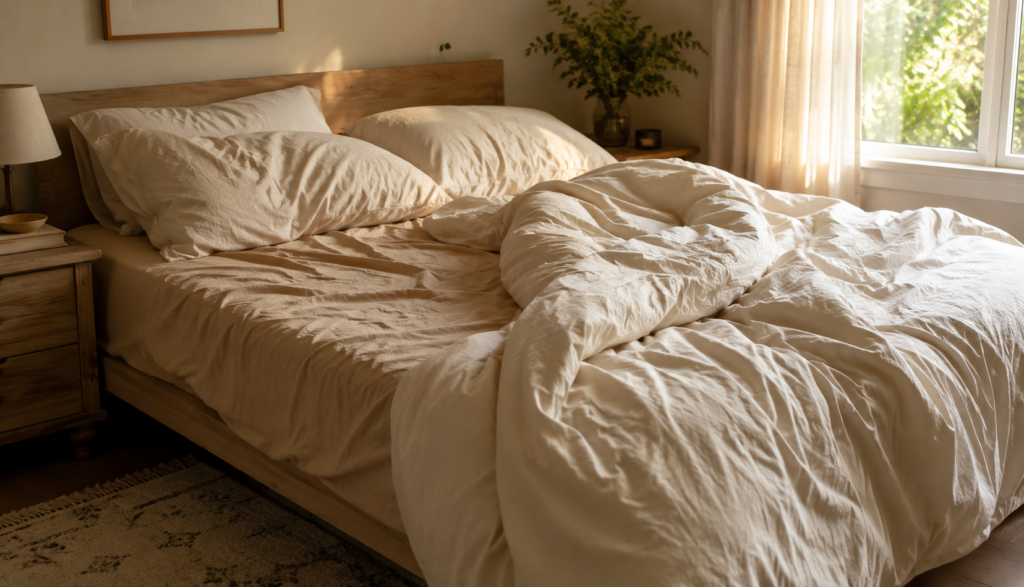
When two people share a single duvet, every movement one person makes — rolling over, adjusting position, pulling the blanket slightly to one side — has the potential to disturb the other person’s coverage, temperature, or physical space. This might seem minor in isolation, but sleep research on partner-related sleep fragmentation consistently shows that these small, repeated disruptions accumulate across the night into measurably reduced sleep quality, even when neither partner remembers waking up or being disturbed. The disruptions are frequently brief enough to qualify as micro-arousals — partial awakenings that don’t reach full conscious memory but that still pull the sleeper out of deeper sleep stages and fragment the overall architecture of the night.
Temperature preference mismatch compounds this problem significantly. It’s extremely common for two people sharing a bed to have genuinely different thermal comfort needs, driven by individual differences in metabolism, body composition, hormonal factors, and even something as simple as one person sleeping more centrally under a shared blanket than the other. With a single shared duvet, one person is frequently too warm while the other is too cold, and the compromise position — whatever ends up being negotiated through unconscious blanket-pulling throughout the night — rarely satisfies either person’s actual thermal needs. This mismatch directly interferes with the core body temperature drop both partners individually need for sleep onset and sustained deep sleep, described in detail in research on sleep temperature, except now there are two separate thermoregulatory systems competing for control over a single shared resource.
What surprised me researching this was how much of what gets blamed on “just being a light sleeper” or “not sleeping well with someone else in the bed” actually traces back to this specific, fixable mechanical and thermal conflict rather than something inherent about sharing a bed in general. Studies comparing sleep quality metrics for the same individuals sleeping alone versus with a partner consistently find measurable differences in sleep efficiency and night waking — and a meaningful portion of that gap closes when the shared blanket variable specifically is removed from the equation, even while everything else about sharing the bed remains the same.
The Cultural Origins and Practical Logic Behind the Nordic Approach
The practice of separate duvets in Scandinavian countries developed well before formal sleep science existed to explain why it worked, emerging instead from a more straightforward practical observation repeated across generations — that two people sharing one blanket frequently ended up unsatisfied with either temperature or coverage, while two people each having full control over their own bedding simply slept better and argued less about thermostat settings and blanket-stealing. This kind of folk wisdom, developed through generations of direct experience rather than controlled research, often turns out to align with what formal investigation later confirms, and the Scandinavian sleep method is a clear example of that pattern.
The approach also reflects a broader Nordic cultural tendency toward prioritizing individual comfort and practical function within shared domestic spaces, rather than treating shared symbolic gestures — like a single shared blanket — as inherently more meaningful than the practical outcome of actually sleeping well. This isn’t a uniquely Scandinavian insight in principle, but the specific bedding tradition crystallized there in a way that became culturally normalized and visible enough to eventually attract attention and a recognizable name outside the region, even as similar practical adaptations likely emerged independently and less formally in other cultures and households without becoming as widely recognized or labeled.
From experience looking at how this method gets discussed in different contexts, there’s sometimes a misconception that separate duvets reflect emotional distance or a lack of intimacy between partners — a narrative that doesn’t hold up well against either the cultural context it emerged from or the actual relationship satisfaction data available. Couples using separate bedding report sleep quality improvements without corresponding declines in relationship satisfaction or perceived closeness, suggesting that the emotional and physical intimacy of sharing a bed isn’t meaningfully dependent on sharing the exact same piece of fabric covering both bodies throughout the night.
What the Modern Research Says About Shared Sleep and the “Sleep Divorce” Trend
The Scandinavian sleep method has gained renewed visibility recently partly through its association with the broader “sleep divorce” conversation — a term describing couples who choose to sleep in separate beds or rooms specifically to improve individual sleep quality, while maintaining their relationship and often their physical intimacy in other ways. Separate duvets represent a notably less drastic version of this same underlying principle: rather than separating entirely, couples address the single most disruptive shared element — the blanket — while still sharing the same bed, same room, and same nighttime routine in every other respect.
Research on relationship and marital satisfaction connected to sleep quality consistently finds that poor sleep, particularly sleep that’s disrupted by a partner’s movement or differing needs, correlates with reduced relationship satisfaction, increased conflict, and reduced emotional regulation capacity during the day — patterns that can compound into genuine insomnia if the disruption becomes chronic — the same emotional and cognitive consequences of general sleep deprivation, specifically triggered by partner-related sleep disruption in this case. This creates a somewhat counterintuitive but well-supported conclusion: addressing the mechanical sources of shared-bed sleep disruption, including through something as simple as separate duvets, can directly support relationship quality rather than undermining the togetherness that sharing a single blanket is sometimes assumed to represent.
Sleep researchers studying couples specifically have noted that the people most likely to benefit from interventions like separate duvets are those with mismatched temperature preferences, different movement patterns during sleep — one notably more restless than the other — or significant differences in preferred mattress firmness that a single shared mattress and bedding setup can’t adequately address for both people simultaneously. For couples without these specific mismatches, the benefit of separate duvets may be more modest, though even relatively well-matched couples frequently report some improvement simply from eliminating the low-level negotiation over blanket coverage that happens unconsciously throughout most shared-bed nights.
What Most People Don’t Know: Mattress Choice Matters as Much as the Duvet
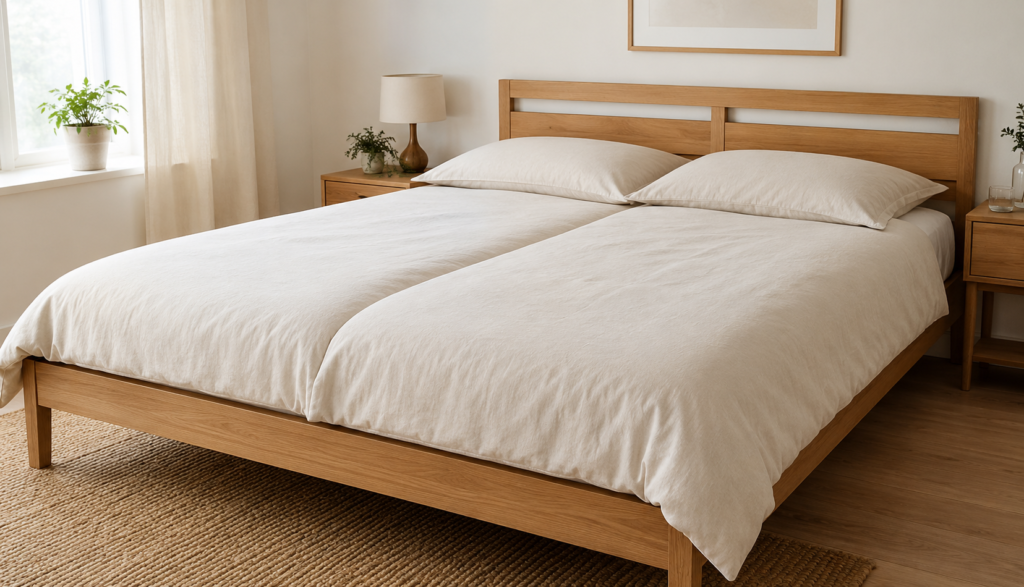
Here’s an extension of the Scandinavian sleep method that gets less attention than the duvet aspect specifically: many Nordic households also favor twin mattresses pushed together under a shared bed frame, rather than a single king or queen mattress, which addresses motion transfer in addition to the temperature and coverage issues that separate duvets solve. Motion transfer — the degree to which movement on one side of a mattress is felt on the other side — is a significant and frequently overlooked contributor to partner-related sleep disruption that separate duvets alone don’t address, since a restless partner can still disturb a single shared mattress surface even with completely independent bedding on top of it.
Mattresses designed with strong motion isolation — typically memory foam or pocketed coil constructions rather than traditional innerspring mattresses with interconnected coils — significantly reduce this transfer effect even on a single shared mattress, providing a partial solution for couples who don’t want to commit to the twin-mattress version of the Nordic approach. But for couples with significant differences in movement patterns or mattress firmness preference, the combination of separate duvets and either separate mattresses or a mattress with genuinely strong motion isolation tends to produce the most complete version of the underlying principle — minimizing every form of unwanted cross-disruption between two people sharing a sleep space, rather than addressing only the temperature and coverage component that the duvet alone resolves.
From experience looking at how couples actually implement these combined approaches, the full twin-mattress version tends to feel like a bigger psychological leap for most couples than separate duvets alone, even though the actual sleep quality benefit can be comparable or greater when motion transfer is a significant factor. Starting with separate duvets on a shared mattress is a lower-friction entry point that delivers a meaningful portion of the total available benefit, and couples can assess afterward whether motion transfer remains a significant enough issue to justify the more substantial mattress change.
How to Try the Scandinavian Sleep Method Without Losing the Shared Bed Experience
Implementing separate duvets doesn’t require any special Scandinavian-branded product — any two duvets of appropriate size for the bed, each suited to each individual’s temperature preference, accomplish the core mechanism. One partner who runs warm can use a lighter, more breathable duvet while the other uses a heavier, warmer option, and neither needs to compromise or unconsciously negotiate coverage through the night. For a king or queen bed, two full or queen-sized duvets typically provide adequate coverage and overlap in the middle without requiring precisely matched sizing to the mattress itself.
Maintaining the shared bed experience while using separate duvets is straightforward in practice, and it pairs well with other steps toward fixing a disrupted sleep schedule — the duvets sit on top of the same shared mattress, in the same shared bed and room, and the visual and physical experience of sharing a bed remains largely intact apart from the specific top layer of bedding.
Many couples report that the change is far less noticeable in terms of feeling distant from a partner than they initially expected, precisely because the actual physical closeness of sharing a bed has very little to do with which specific blanket is covering each person.
Using our Sleep Debt Calculator to compare accumulated sleep loss before and after switching to separate duvets gives a more objective basis for evaluating whether the change is producing the improvement the method is known for, rather than relying purely on subjective impressions that can be influenced by simply trying something new.
For couples who find the duvet change alone insufficient, particularly where motion transfer or significant mattress firmness mismatch remains a contributing factor, exploring mattress options with strong motion isolation or considering the more substantial twin-mattress approach represents a logical next step rather than concluding the underlying principle doesn’t apply to their specific situation.
If sleep disruption from sharing a bed persists significantly despite addressing bedding, temperature, and mattress factors, and is accompanied by signs like snoring, breathing pauses, or excessive daytime fatigue in either partner, a doctor or sleep specialist is always worth consulting — shared-bed disruption can sometimes mask or compound an underlying sleep disorder in one partner that bedding adjustments alone won’t resolve.
Frequently Asked Questions

A: The Scandinavian sleep method is a Nordic bedding tradition where each person in a shared bed uses their own individual duvet rather than one shared blanket. It addresses temperature mismatch and reduces sleep disruption caused by a partner’s movement or differing coverage needs throughout the night.
A: Yes, for many couples. It addresses two well-documented sources of partner-related sleep disruption — temperature preference mismatch and micro-arousals caused by shared blanket movement. Couples with significantly different thermal needs or restless sleep patterns tend to see the most noticeable improvement.
A: Research and reported experience suggest no meaningful negative impact. Couples using separate bedding generally report improved sleep quality without corresponding declines in relationship satisfaction or perceived closeness, since the physical and emotional intimacy of sharing a bed doesn’t depend on sharing the same blanket.
A: A sleep divorce typically involves couples sleeping in separate beds or rooms entirely. The Scandinavian sleep method is a less drastic alternative — couples remain in the same bed and room but use separate duvets to address the specific disruption caused by sharing one blanket.
A: Any two duvets of appropriate size for the bed work, typically full or queen-sized duvets for a king or queen bed, with each person choosing weight and warmth suited to their individual temperature preference. No special branded product is required to implement the method.
A: For couples with significant differences in movement patterns or mattress firmness preference, separate mattresses or a mattress with strong motion isolation can address motion transfer issues that separate duvets alone don’t resolve. This is a more substantial change typically considered after testing separate duvets first.
A: Differences in metabolism, body composition, and hormonal factors all influence individual thermal comfort during sleep. These differences mean two people sharing a single blanket frequently have mismatched temperature needs, with one partner often too warm while the other is too cold under the same shared coverage.
A Simple Fix With Real Evidence Behind It
The Scandinavian sleep method solves a specific, well-documented problem — the mismatch in temperature and movement that happens when two people share a single blanket — without requiring couples to give up sharing a bed or compromise on closeness. It’s a low-cost, low-effort change with genuine mechanistic support, and for couples who’ve never questioned why sharing a bed feels less restful than sleeping alone, it’s one of the more straightforward variables worth testing before assuming the disruption is simply unavoidable.